Armed drone swarms haven’t appeared on the battlefield yet — but the experts building counter-UAS systems say the technology is close, the threat is real, and the US military’s procurement bureaucracy is the primary reason defenses aren’t keeping pace.
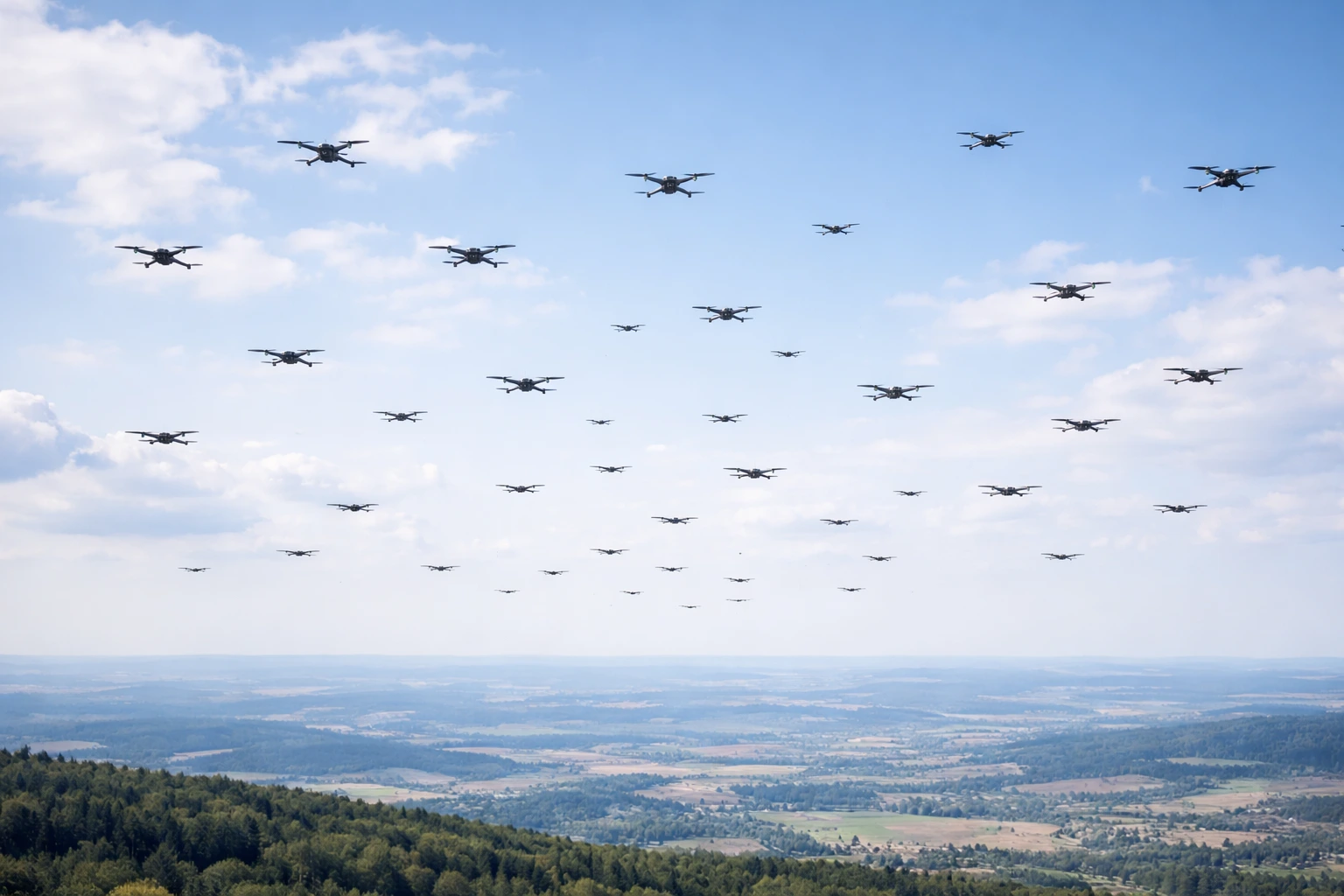
That assessment came from a panel of counter-drone specialists at AFCEA’s TechNet Transatlantic in Frankfurt last December, and it’s worth taking seriously. Ukraine has demonstrated mass drone deployment — dozens of aircraft in the air simultaneously — but not true coordinated swarms with centralised command and control. The distinction matters because the countermeasures required are fundamentally different.
What Makes Swarms Hard to Stop
Current counter-UAS detection relies on four sensor types: radio frequency, radar, optics, and acoustics. For individual drones or uncoordinated mass attacks, layering these systems works. For an autonomous swarm operating without RF emissions — pre-programmed, GPS-guided, silent — the problem becomes significantly harder.
“How do we detect these kinds of objects with what kind of sensors?” asked David Sonntag of Walaris GmbH. “And if the swarm then splits up, which part of the swarm is the one that we should follow with which sensors?”
The answer, according to the panel, requires distributed sensor networks coordinated by AI — systems capable of tracking and classifying up to 40 objects simultaneously, assigning each a unique identifier and maintaining that track even when drones occlude each other. Walaris has edge AI processing that does this today, but it’s one component of a much larger unsolved problem.
Payload detection is the hardest piece. A swarm is likely to contain a mix of ISR drones, strike drones, and decoys. Telling them apart in real time — acoustically, visually, or otherwise — is a capability that, by the panel’s admission, no company has solved yet. “I don’t know any company who has great solutions for payload detection right now,” Sonntag said.
Directed Energy Is Not the Near-Term Answer
Lasers are the obvious kinetic solution for swarms — no ammunition constraints, speed-of-light engagement. The panel was clear-eyed about the limitations. Atmospheric conditions degrade effectiveness. Drones are getting harder to burn through. And automated target tracking for fast-moving objects requires the laser to stay precisely on target long enough to cause damage — a software and hardware challenge that isn’t solved at scale.
Directed energy works in the right conditions. It’s not a universal answer.
The Bureaucracy Problem
The panel’s sharpest criticism wasn’t directed at the technology gap — it was directed at the military itself. Program offices move too slowly. Field updates require certification cycles that can take months. Systems that work are left unpatched because operators don’t want to open up a running system and wait for re-approval.
“What we found consistently was that the program offices move too slow for the threat,” said Glenn Larish of NexTech Solutions. Drone technology iterates in weeks. Defense procurement iterates in years. That gap is the actual vulnerability.
Ukraine has adapted faster than any NATO military precisely because it has no choice — and because it operates outside the procurement frameworks that slow everyone else down. The lesson for US base security, which remains significantly underprotected against small UAV threats, is that speed of adaptation matters as much as the quality of the technology.
The swarm threat is a software problem as much as a hardware one. The military’s ability to update software in the field will determine whether its counter-UAS systems stay relevant.