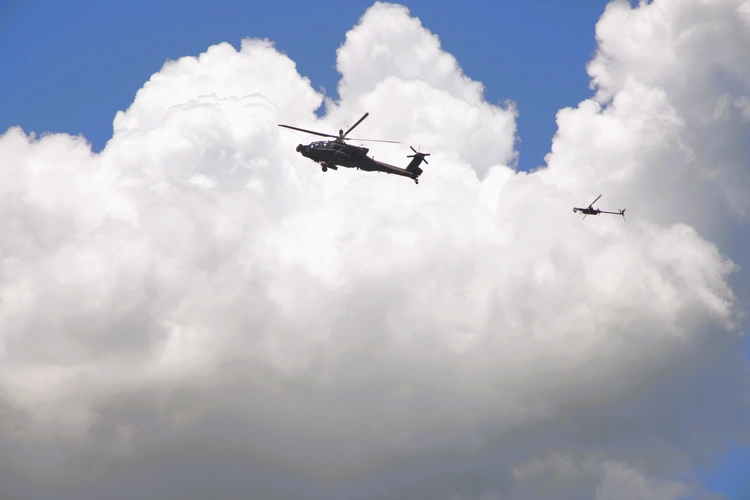
The US Army has demonstrated an Apache-launched A700 drone capability built in under six months, compressing a development cycle that typically takes years.
The test, conducted on 26 February, showed an AH-64E Apache deploying an A700 unmanned aircraft as part of its Launched Effects concept — extending the helicopter’s reach beyond its own sensors and weapons.
A six-month cycle under real constraints
The capability moved from requirement to live demonstration in less than six months, starting in late summer 2025.
Multiple Army organizations were involved, including Training and Doctrine Command, Futures Command, and the Combat Capabilities Development Command, alongside aviation program offices and industry partners.
The speed is the signal. This is not a new platform — it is a new capability layered onto an existing one.
Extending the Apache beyond line of sight
The A700 drone is part of the Army’s Launched Effects push, designed to give crewed platforms access to distributed sensing and strike options.
From an Apache, that translates into forward reconnaissance, electronic warfare, and potential strike capabilities without exposing the aircraft itself.
Instead of flying into contested airspace, the helicopter can push assets ahead of it.
That changes how the platform is used. Less direct engagement, more coordination and control.
The Army positions the capability as a way to close gaps in intelligence, surveillance, and reconnaissance while extending kinetic and electronic warfare reach.
Ground commanders gain more flexibility. Units can see further, act earlier, and distribute effects across a wider area without adding new aircraft to the fleet.
It is a multiplier, not a replacement.
A model for how programs are expected to run
Officials framed the effort as both a technical and organizational milestone. The goal is not just the capability itself, but the process behind it.
Rapid integration, cross-unit coordination, and shorter development cycles are becoming requirements, not exceptions.
The Army is trying to prove it can move faster without waiting for full program cycles or new platform procurement.
What to watch
The next step is whether this moves beyond demonstration into operational deployment.
If it does, Apache units gain a new layer of reach without changing the platform itself. More importantly, it sets a precedent: future capabilities may arrive as modular upgrades, not decade-long programs.
That is a shift in how military aviation evolves — faster, incremental, and closer to how software is deployed.