
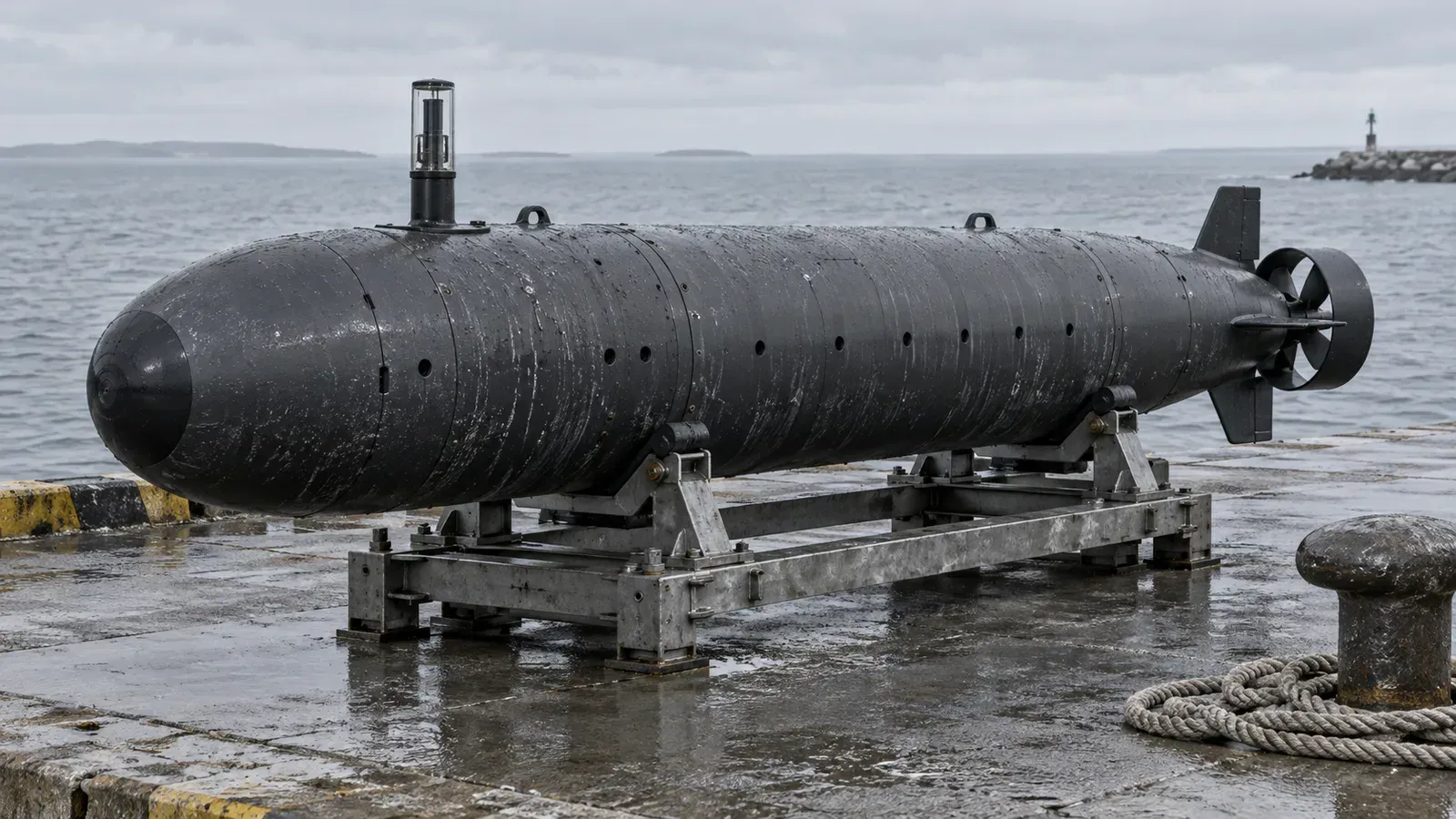
Iran’s Islamic Revolutionary Guard Corps said on 8 September that its navy had captured an American underwater drone near the entrance to the Strait of Hormuz, and state media showed pictures of a torpedo-shaped vehicle with Anduril markings on a quayside.
US Central Command did not dispute that Iran had it. Navy Capt. Tim Hawkins, the command’s spokesman, said the vehicle had “malfunctioned more than a day ago” and was “essentially dead in the water for more than a day” before it was picked up. He said it was an older model that “neither collected sensitive data nor carried any classified sonar or radar equipment,” and that US operations in the area’s waters continue.
The vehicle is a Dive-LD, which Anduril sells for about $2.5 million. It is 5.8 metres long, 1.2 metres across and weighs about three tonnes, and it is built for multi-week autonomous missions: mine countermeasures, seabed mapping, intelligence collection and inspecting cables and pipelines. H I Sutton, who writes on submarine technology for Naval News, matched the Iranian photographs to the Dive-LD by its flood holes, fastenings, transparent mast and X-form rudders before either side had confirmed the type.
Two descriptions of one drone
The IRGC Navy called the vehicle a “prize” and said it had been delivered to the US military in 2025. CENTCOM says it was on a hydrographic survey when it failed. Both can be true, and neither side has explained why a vehicle that had been drifting for more than a day was not recovered by the US first.
Anduril’s response was that the Dive-LD is an “attritable autonomous system,” designed from the outset for environments where losing it “is an expected possibility,” and that the vehicle had “delivered significant value operating thousands of hours” in months-long CENTCOM deployments. That is the company’s framing and it is also the product’s sales case: a $2.5 million vehicle that can be lost is the alternative to a crewed vessel that cannot.
FlightBrief analysis: what Iran has is a three-tonne hull, a propulsion section and whatever navigation and survey electronics an older Dive-LD carries. What it does not have, on CENTCOM’s account, is the sensor payload that would make the capture worth more than the pictures. Iran has done this before with American drones — the RQ-170 in 2011, a ScanEagle in 2012 — and each time the value was in the announcement.
The Dive-LD serves with the US Navy’s Unmanned Undersea Vehicle Group 1 and Undersea Vehicle Squadron 3. Anduril also supplies the Navy with the larger Dive-XL, which was not involved.