Tekever
Portuguese maker of the AR3 and AR5 long-endurance surveillance drones, building the British Army's Watchkeeper replacement in Swindon.
1 article
What It Is
Tekever builds fixed-wing surveillance drones and the software that turns their sensor feeds into intelligence. It was founded in Portugal in 2001 by researchers in artificial intelligence and distributed systems, and says it was bootstrapped from the start. Ricardo Mendes, a founder, is chief executive.
The company lists offices in Lisbon, Bristol, Toulouse, Fayetteville in North Carolina and Tallinn. It says it employs more than 1,500 people. Its buyers are mostly armed forces, and Ukraine’s have flown its drones in combat since 2022.
Key Products
AR3 is the small aircraft. Tekever says it weighs 25 kg, or 30 kg in its vertical take-off version, carries 6 kg and flies for up to 22 hours. It launches by catapult or vertically and lands by parachute or vertically. AR3 EVO is the current version, and the Royal Air Force flies an AR3 variant called StormShroud.
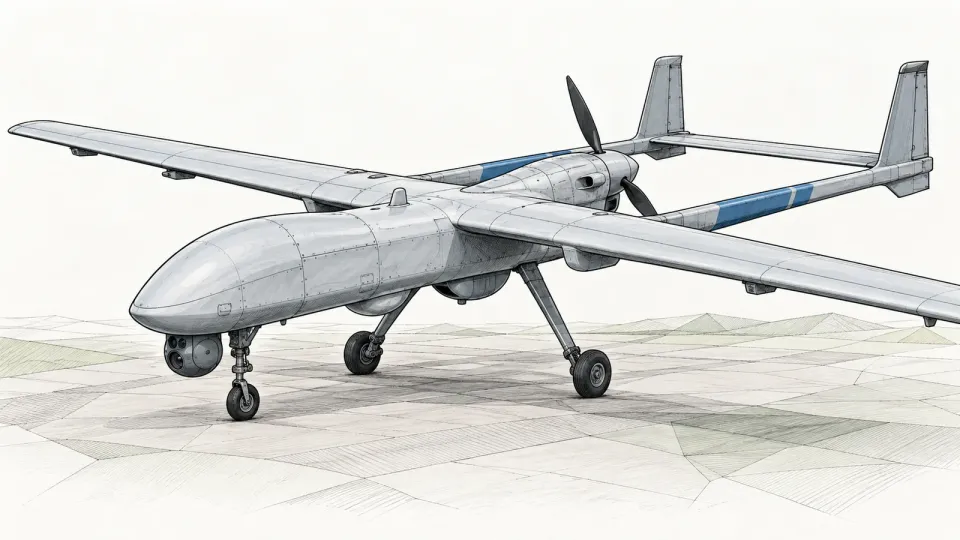
AR5 is the larger aircraft and now the flagship. The company says it carries 50 kg of sensors for 20 hours at about 100 km/h, and takes off and lands on unprepared strips. It is the aircraft behind the British Army’s CORVUS programme and an August 2026 order from the Portuguese Air Force for maritime patrol.
AR6, unveiled in July 2026, is a heavy-lift family designed and built in the UK. Tekever also sells ATLAS, which delivers drone-gathered intelligence as a service.
Business and Financial Position
Tekever is private and does not publish revenue. In May 2025 it said a round taken up entirely by existing investors valued it above £1 billion. On 23 September 2026 it announced the first close of a $580 million Series D at a $6.4 billion valuation, led by UC Investments, the University of California’s investment office, and Baillie Gifford. It expects further closings.
Much of its expansion is in Britain. In September 2025 the UK government announced a 254,000 sq ft Tekever factory in Swindon, the company’s fourth UK site, to bring AR5 production to Britain for the first time. Tekever ties it to a £400 million investment programme it calls OVERMATCH and up to 1,000 jobs over five years. It has also bought West Wales Airport for flight testing and, in September 2026, Flowcopter, an Edinburgh propulsion firm.
On 25 July 2026 the Ministry of Defence chose the AR5 to replace the Army’s Watchkeeper, in service since 2014. The CORVUS deal is worth up to £400 million over ten years: an initial six aircraft, and up to 24 by 2029. Tekever says it signed the contract on 16 September 2026.
Why It Matters
Tekever’s case rests on Ukraine. The UK government says Britain has bought about £270 million of its drones for Ukraine since 2022, and Tekever says its aircraft have logged more than 50,000 operational hours there. Defence Secretary Wes Streeting called the AR5 “Proven in Ukraine” when he picked it for the Army.
CORVUS moves the company from wartime supplier to a programme of record. It also puts a great deal on one new building. The Army’s AR5s are to be built in Swindon, and the ministry said in July that the plant had yet to open. A $6.4 billion valuation with no published revenue leaves the delivery of those 24 aircraft by 2029 as the public test.
Coverage
Topics
Funding
Contracts
Project CORVUS: AR5 long-endurance surveillance drones to replace the British Army's Watchkeeper, up to £400 million…