

Black Widow
The US Army's chosen short-range reconnaissance drone, built for rucksack portability and GPS-denied flight — its position rests on winning the SRR program of record rather than on any single specification.
- Rating
- 4.2/ 5
- Weight
- 1.93 kg (4.26 lb)
- Flight time
- 45+ min
- Price
- On request
- Made by
- Red Cat Holdings
Where to buyGovernment procurement; Red Cat quotes on request
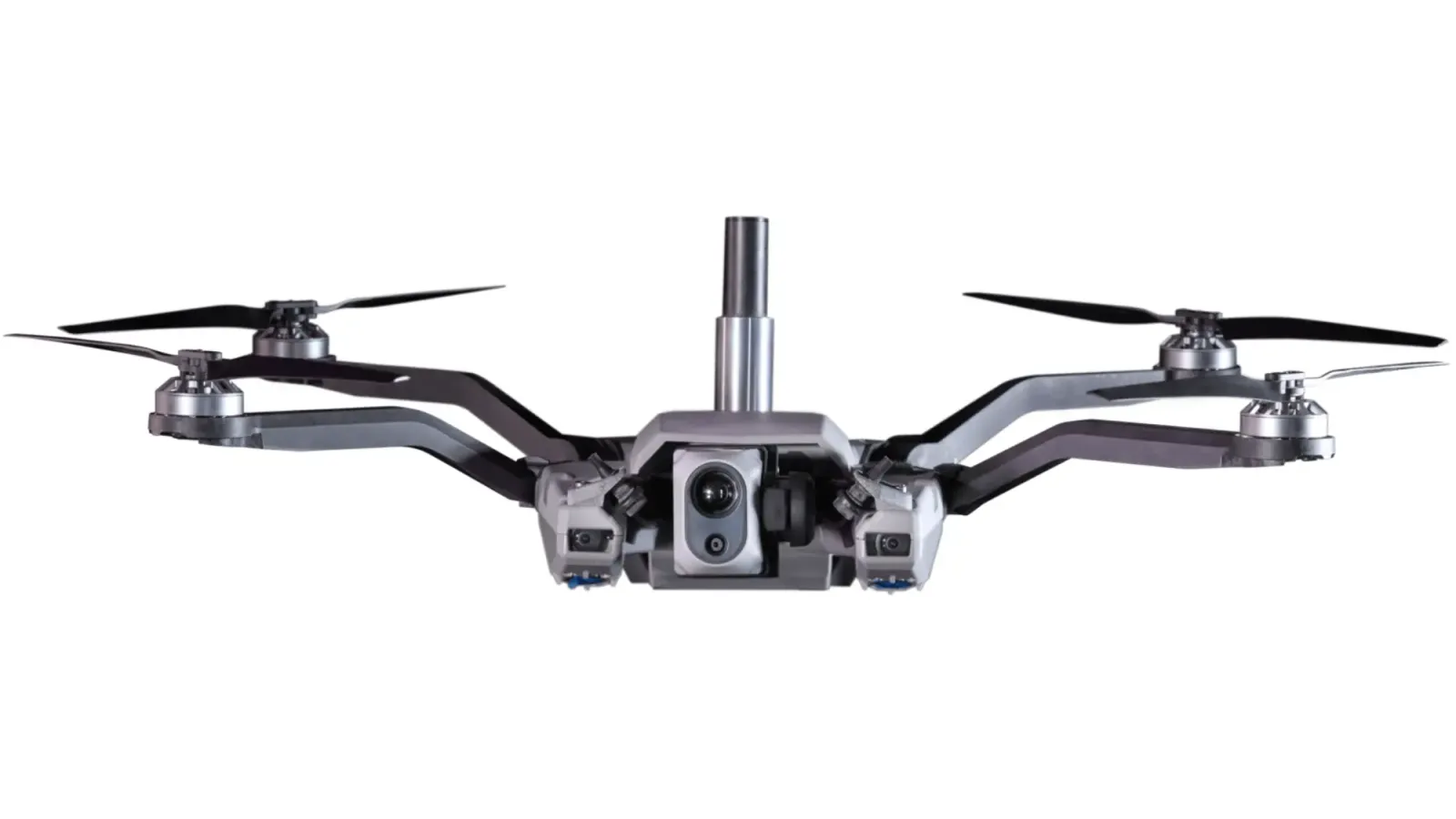
The Black Widow is a short-range reconnaissance drone built by Teal Drones, a subsidiary of Red Cat Holdings, for small-unit ISR. It is designed to be carried in a rucksack, launched by an individual soldier, and flown in environments where GPS is jammed or spoofed.
Its significance is procedural rather than technical. In November 2024 the US Army selected Teal as the production winner of its Short Range Reconnaissance programme of record, following a multi-tranche competitive evaluation. Red Cat states the Army’s acquisition objective is 5,880 systems over a five-year period of performance, which the company notes is subject to change. No contract value was disclosed. In September 2025 the system was approved for the NATO Support and Procurement Agency catalogue, on a three-year contract with two optional additional years, opening procurement to NATO members and partners. On 30 July 2026 the US Air Force Security Forces Center placed a $2.49 million order to assess the Black Widow as a successor to its Teal 2 fleet.
Specifications
| Specification | Black Widow |
|---|---|
| Weight | 4.26 lb / 1.93 kg |
| Endurance | 45+ minutes |
| Link range | 5 miles / 8 km |
| Max speed | 13 m/s (29 mph) |
| Payload | Teledyne FLIR Hadron 640R+ EO/IR |
| EO sensor | 64 MP, 67° HFOV, 4K at 30 fps |
| IR sensor | Boson+ 640 radiometric, 32° HFOV |
| Processor | Qualcomm RB5 (eight Kryo 585 cores, Adreno 650 GPU) |
| Navigation | Visual navigation for GPS-denied environments |
| Radio | Doodle Labs hex-band, with frequency stepping against jamming |
| Country of manufacture | United States |
All figures are Teal’s published specifications, checked against Teal’s specification page on 29 September 2026. FlightBrief has not flown the aircraft.
A note on the weight figure. Teal’s published specification is 4.26 lb (1.93 kg), and that is the number used above. Red Cat’s own NSPA press release describes the system as “under 3 lbs” with rucksack portability, and third-party dealers list 3.6 lb. These almost certainly describe different configurations — aircraft alone versus a fitted-out system — but Red Cat has not reconciled them publicly. Anyone buying against a weight requirement should confirm the configuration in writing.
Red Cat’s own figures disagree. Teal’s page gives 45+ minutes, 13 m/s and 8 km. Red Cat’s product page gives 50+ minutes, and its sales storefront gives 50+ minutes, 18 m/s and 11 km. The table uses Teal’s, the manufacturer’s own specification page; the storefront is the newest. Ask which configuration a quote refers to.
Teal does not publish wind resistance, operating temperature or dimensions, and none are asserted here.
Red Cat’s storefront also lists a Black Widow AiN on the same airframe. It adds assured positioning and navigation for areas where GPS cannot be relied on, Next Generation Command and Control, and an offset radio. Its specifications are not yet published.
Use Cases
Squad-level ISR in electronically contested environments, where commercial drones fail to jamming or spoofing. Urban reconnaissance for building clearance and route assessment. Perimeter monitoring where a small, replaceable platform is preferable to committing a larger ISR asset.
Market Context
The Black Widow is US-manufactured, which keeps it clear of the NDAA Section 848 restrictions on Chinese-made aircraft. It is on the Blue UAS Cleared List: DIU selected it for assessment in February 2025, and the official DCMA list, read on 8 October 2026, shows it with a date added of 7 April 2026. See the Blue UAS Cleared List guide for how that route works.
Its closest comparison is the Skydio X2D, the platform it beat in the SRR competition. The Skydio X10 is a larger inspection and observation aircraft in a different class, not a direct rival. Parrot’s ANAFI USA remains the other established NDAA-compliant option in the small-ISR segment.
The realistic read is that the SRR win, not the specification sheet, is what matters here. A 5,880-system objective makes the Black Widow the default US Army squad reconnaissance drone for the rest of the decade if Red Cat can deliver at rate — and Red Cat is a small company whose ability to manufacture at that volume is unproven. That execution risk, rather than any competing platform, is the thing to watch.
Compared
| Specification | Black Widow | Skydio X10 | DJI Matrice 4T |
|---|---|---|---|
| Weight | 1.93 kg (4.26 lb) | 2.11 kg (4.65 lb) | 1,420 g |
| Flight time | 45+ min | up to 40 min | 49 min |
| Price | On request | On request | $7,849 |
| Where to buy | Government procurement; Red Cat quotes on request | Skydio direct and resellers; price on quote | Dealers and Amazon |
| Launched | — | Feb 28, 2024 | Jan 8, 2025 |
Figures are the manufacturers' published specifications, as on each product's page.