
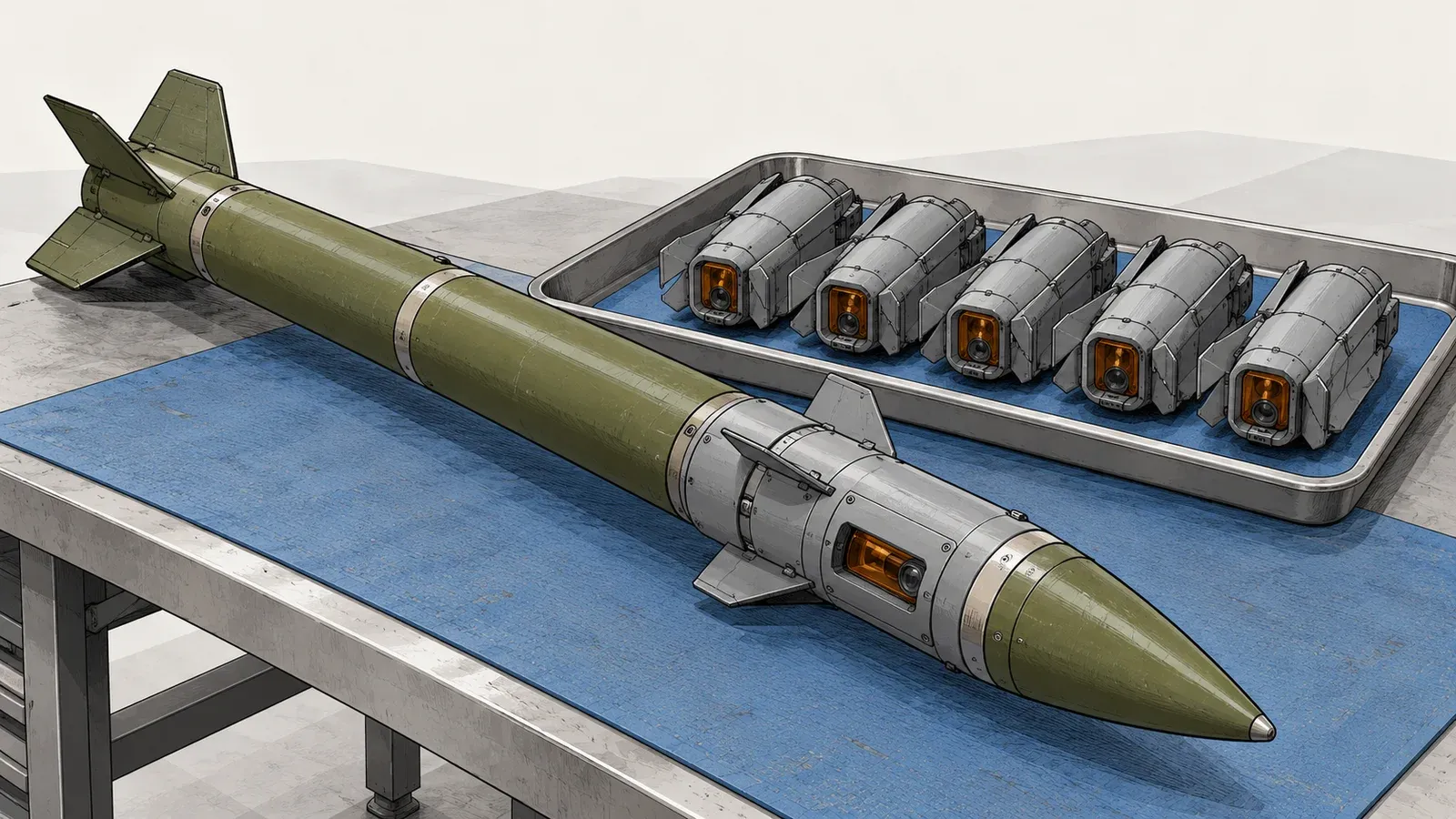
The US Department of War plans to buy up to 25,000 APKWS guidance kits a year from BAE Systems for up to seven years. The kits turn an unguided 70 mm rocket into a laser-guided one, and the US military now fires them at drones.
The framework, announced on 19 October, is not yet a contract. The department says the purchases are “pending congressional authorization and appropriations”. BAE says it will raise output while it negotiates a multi-year contract. Neither side gave a value.
Allies could push the number higher. The department describes a path to 35,000 a year once partner nations file Foreign Military Sales requests. Michael Duffey, Under Secretary of War for Acquisition and Sustainment, said the deal “flips the cost calculus in the taxpayer’s favor.”
A cheap rocket aimed at drones
APKWS is a guidance section that fits between a rocket’s motor and its warhead. With a proximity fuze it bursts next to a small drone instead of needing a direct hit. In a 2023 test for the Pentagon’s counter-drone office, BAE reported a 100% success rate against drones of 25 to 50 pounds.
The Navy’s 2027 budget prices each guidance section at $31,717. It says demand for its rockets rose because their use “now includes the C-UAS mission area”. The Navy asked for 1,120 guidance sections for 2027 and 263 more for Marine ground units, up from 916 in total for 2026. The Army and Air Force buy theirs through their own budgets.
Three times the average so far
BAE delivered its 100,000th kit in February, after more than 12 years at full-rate production. By FlightBrief’s arithmetic that averages fewer than 8,400 a year. The 25,000 figure is not new. In March 2023 BAE said it “can ramp up to 25,000 units per year”.
Foreign demand is already there. In May the US notified Congress of a possible sale of 10,000 complete APKWS rounds to Qatar, estimated at $992.4 million. BAE builds the kits in Hudson, New Hampshire, and Austin, Texas.
The department has signed seven-year frameworks of this kind for far costlier missiles this year. Lockheed Martin’s, signed in January, aims to raise THAAD interceptor output from 96 to 400 a year.