
DoorDash said on July 29 that its robotics group had won FAA Part 135 air carrier certification and would begin flying its own delivery drones this autumn, under the name DoorDash Air.
It is the eighth US operator to hold the package delivery certificate, alongside Wing, Zipline, UPS Flight Forward and Amazon Prime Air. Getting one means passing a five-stage FAA evaluation covering airworthiness, maintenance and safety procedures. DoorDash is building its own aircraft and has not named launch cities.
It has not dropped Wing or Flytrex, which have been flying its orders since 2022 and June 2025 respectively.
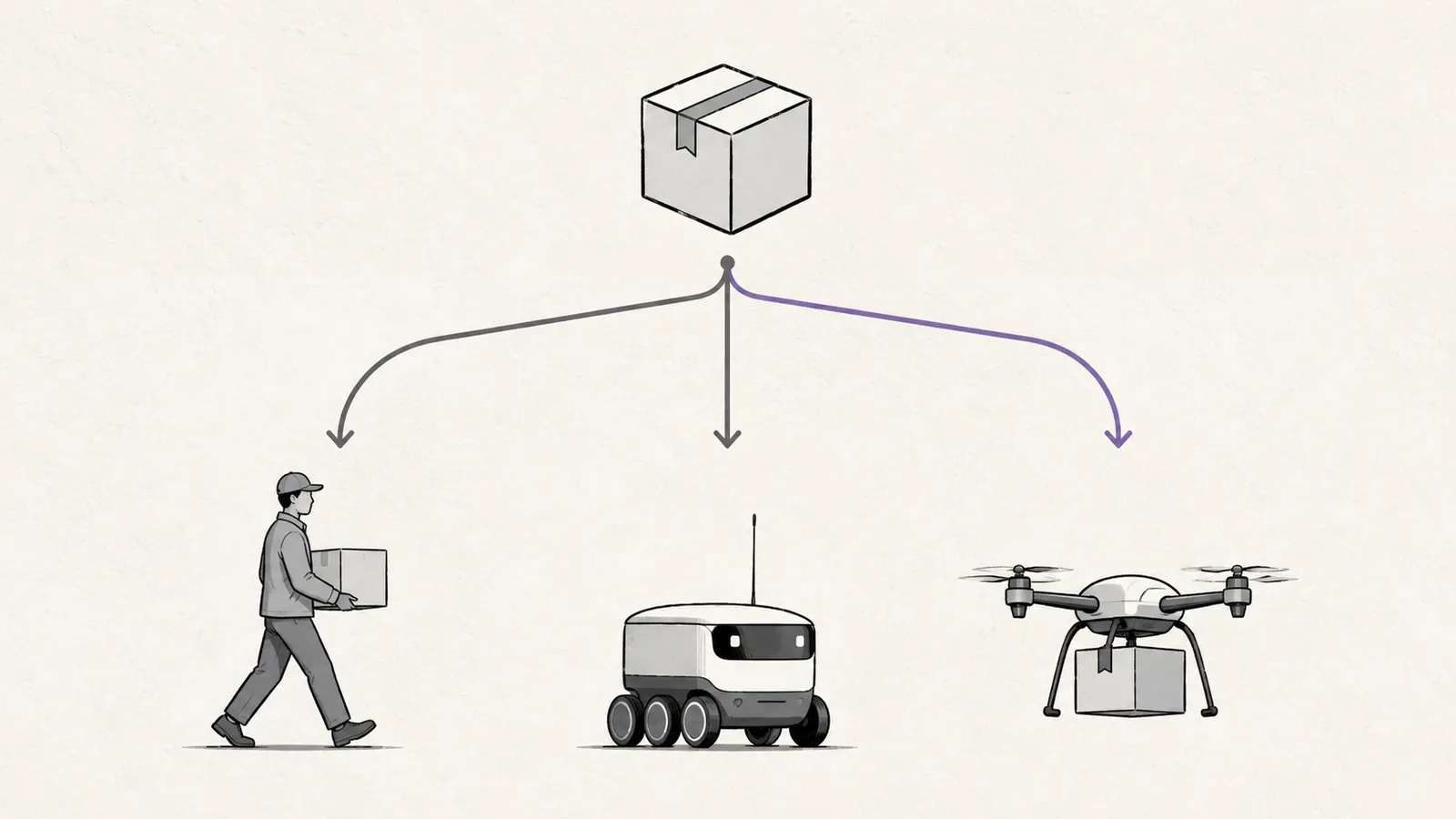
The more consequential piece is the software above the aircraft. DoorDash calls it the Autonomous Delivery Platform, and it decides, per order and in real time, whether your burrito goes out with a human courier, a ground robot, a DoorDash drone or a partner’s drone. The ground robot is Dot, built in the same group and introduced in September 2025 for bike lanes and roads rather than sidewalks alone.
So DoorDash is not building a drone company. It is building a router, and buying enough of a drone company to sit underneath it as one option among several. A marketplace that owns the order, the customer and now the aircraft negotiates from a different position than one that has to buy every flight. That reading is ours, not DoorDash’s — but it is the structure the company has described.
The wider pattern is unkind to the operators. Matternet holds the only FAA type-and-production certificate pair in the industry plus a Swiss operator certificate for flights over populated areas, and reported revenue of $392,739 for the year to September 2025 with a going-concern paragraph in its auditor’s report. DroneUp has Part 135 and lost the Walmart contract that was its business, with no replacement named. The volume leaders are Zipline, past two million deliveries and newly signed with Uber Eats, and Wing, past a million through Walmart. Both attached themselves to demand that already existed.
DoorDash ran that in reverse: demand first, certificate second. Uber has invested in Flytrex and signed with Zipline but has not certified its own operation. If DoorDash Air’s economics work, that will not stay true for long — particularly once the FAA’s Part 108 rule publishes, which would replace site-by-site BVLOS waivers with a standing framework and lower the barrier to running your own aircraft. It reached the White House budget office on 10 July.