DoorDash
US delivery marketplace holding an FAA Part 135 air carrier certificate and running its own drone programme, DoorDash Air, alongside partner drones.
1 article
DoorDash
DoorDash is a US local-commerce marketplace, listed on Nasdaq as DASH, best known for restaurant and grocery delivery. It matters to this sector for a reason that has little to do with food: it is one of the few companies that owns delivery demand at scale and has now acquired the certification to fly that demand itself.
Its autonomy work sits in DoorDash Labs, the internal robotics and R&D group.
Autonomous delivery programmes
DoorDash Air is the in-house drone programme. DoorDash announced on 29 July 2026 that DoorDash Labs had earned FAA Part 135 air carrier certification, making it the eighth US operator to hold the package delivery certification, alongside Wing, Zipline, UPS Flight Forward and Amazon Prime Air. Part 135 requires passing a five-stage FAA evaluation covering airworthiness, maintenance programmes and safety procedures. The company said it is developing a custom aircraft and the systems to manage a delivery from merchant handoff to customer drop-off, with commercial in-house deliveries expected to begin in the autumn of 2026 in cities it has not named.
Dot is a ground robot introduced in September 2025, also built in DoorDash Labs, designed to travel bike lanes, roads and sidewalks rather than sidewalks alone.
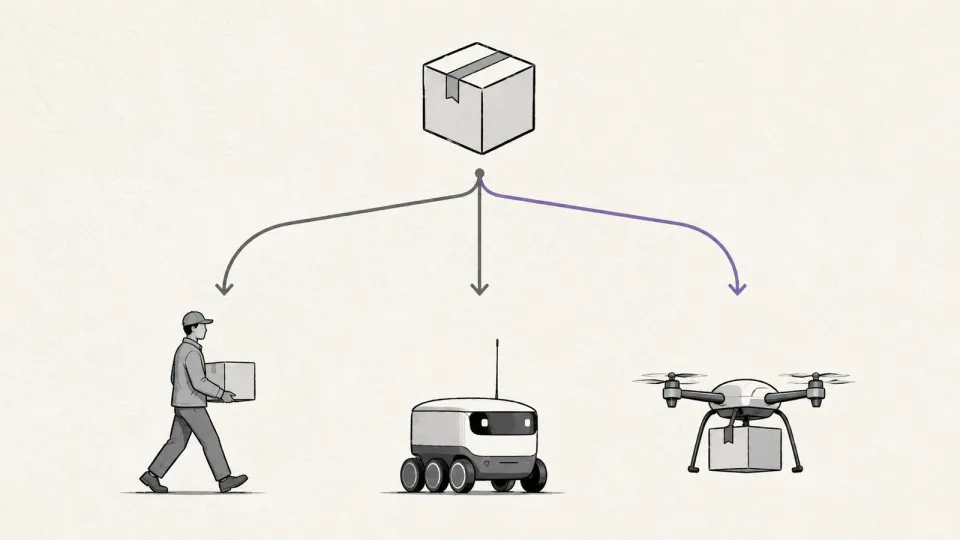
The Autonomous Delivery Platform is the software layer underneath both. DoorDash describes it as deciding, per order and in real time, whether a human courier, a ground robot, a drone or a third-party autonomous partner is the right way to move it.
Relationship with drone operators
DoorDash has been a customer of drone operators since 2022, when it began working with Wing in Australia, expanding to US cities including Dallas-Fort Worth in 2024. It launched joint delivery with Flytrex in Little Elm and Frisco, Texas, in June 2025.
It has kept both partnerships in place after certifying its own operation. Whether that remains a partnership of equals is the open question: a marketplace that routes the order, owns the customer relationship and can also fly the aircraft is in a materially different negotiating position from one that has to buy the flight.
Why It Matters
Most of the drone delivery industry has spent a decade treating regulatory approval as the hard part. DoorDash’s position is the counter-argument. It came to the sector holding demand rather than certificates, acquired the certificate in a few years, and can now choose per order whether to fly its own aircraft or rent someone else’s.
For operators whose commercial strategy depends on plugging into large marketplaces — which is most of them — DoorDash is simultaneously the most valuable customer available and the most credible threat to their position.
Coverage
Topics
Guides
Guide
Drone Delivery Companies: Who's Flying What in 2026
Wing, Zipline, Amazon, Manna, Flytrex, Matternet, DroneUp — where they fly, what they deliver, and why certification was not the hard part.
Guide
Drone BVLOS Rules 2026: FAA Part 108 and EU U-Space
Part 108 is in final review and could make routine BVLOS legal in the US. Europe regulated first and is now simplifying. Where both stand.