
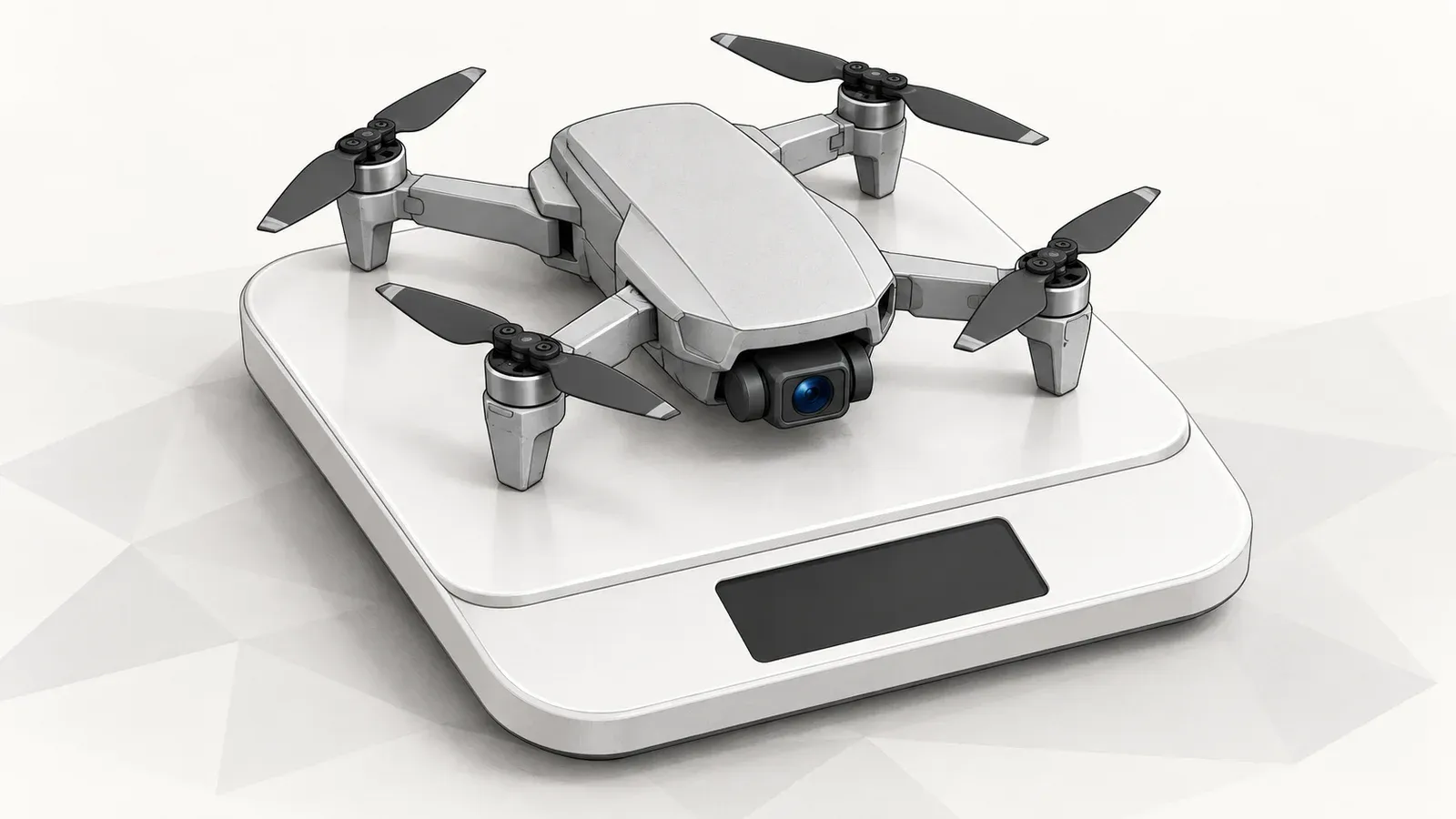
The European Union Aviation Safety Agency wants every drone of 100 g or more in the EU’s open category to have a registered operator and to broadcast its identity. EASA published the proposal, Opinion No 06/2026, on 18 September. Today the 250 g mark decides both, with an extra registration rule for camera drones.
The number did not come from EASA. The European Commission’s Action Plan on Drone and Counter Drone Security, published on 11 February, asked for registration above 100 g and remote identification on smaller drones. EASA says the threshold reflects requirements set by security authorities, “rather than a safety-driven assessment” of its own.
What changes under 250 g
Registration in the EU’s open category now turns on two tests. A drone needs a registered operator at 250 g, or at any weight if it carries a camera and is not a toy. EASA would replace both with a single line at 100 g.
For most camera drones that changes little. The 249.9 g DJI Mini 5 Pro already needs a registered operator because it has a camera. A camera drone lighter than 100 g, which needs one today, would no longer need it.
Remote identification is the bigger change. It broadcasts a drone’s operator number and position to receivers nearby. Today the EU requires it from class C1 upward, which leaves out the C0 class below 250 g. Under the proposal, every drone of 100 g or more in the open category would need it, including the 192 g HoverAir X1 ProMax.
New drones would also have to refuse to take off unless a valid operator number has been loaded. That rule reaches home-built aircraft too.
Drones already sold
Existing aircraft get time. Any drone sold before a date 12 months after the rule takes effect would be spared the take-off block. Drones of 900 g or less would also be spared a remote ID add-on, which EASA judged “technically unfeasible” for aircraft that light. Heavier ones would have four years to fit one.
Britain already registers from 100 g. Its own class scheme took effect on 1 January.
Who objected
EASA received more than 100 comments on the draft. Model aircraft associations and makers of home-built drones called registration and remote ID at 100 g out of proportion, and costly. Some national aviation authorities asked for a higher threshold.
EASA refused to move the number, pointing again to the security authorities. It did drop a planned extension of geo-awareness, the function that warns pilots about restricted zones. Member states would decide whether drones flown in model clubs need remote ID.
It also kept a new duty for member states: to check an operator’s identity before registering them. EASA says its inspections found states applying the current rules differently.
The opinion now goes to the Commission, which decides whether to adopt it. The 100 g registration line would apply as soon as the regulation takes effect. EASA plans a separate opinion simplifying drone rules in the fourth quarter of 2026.