
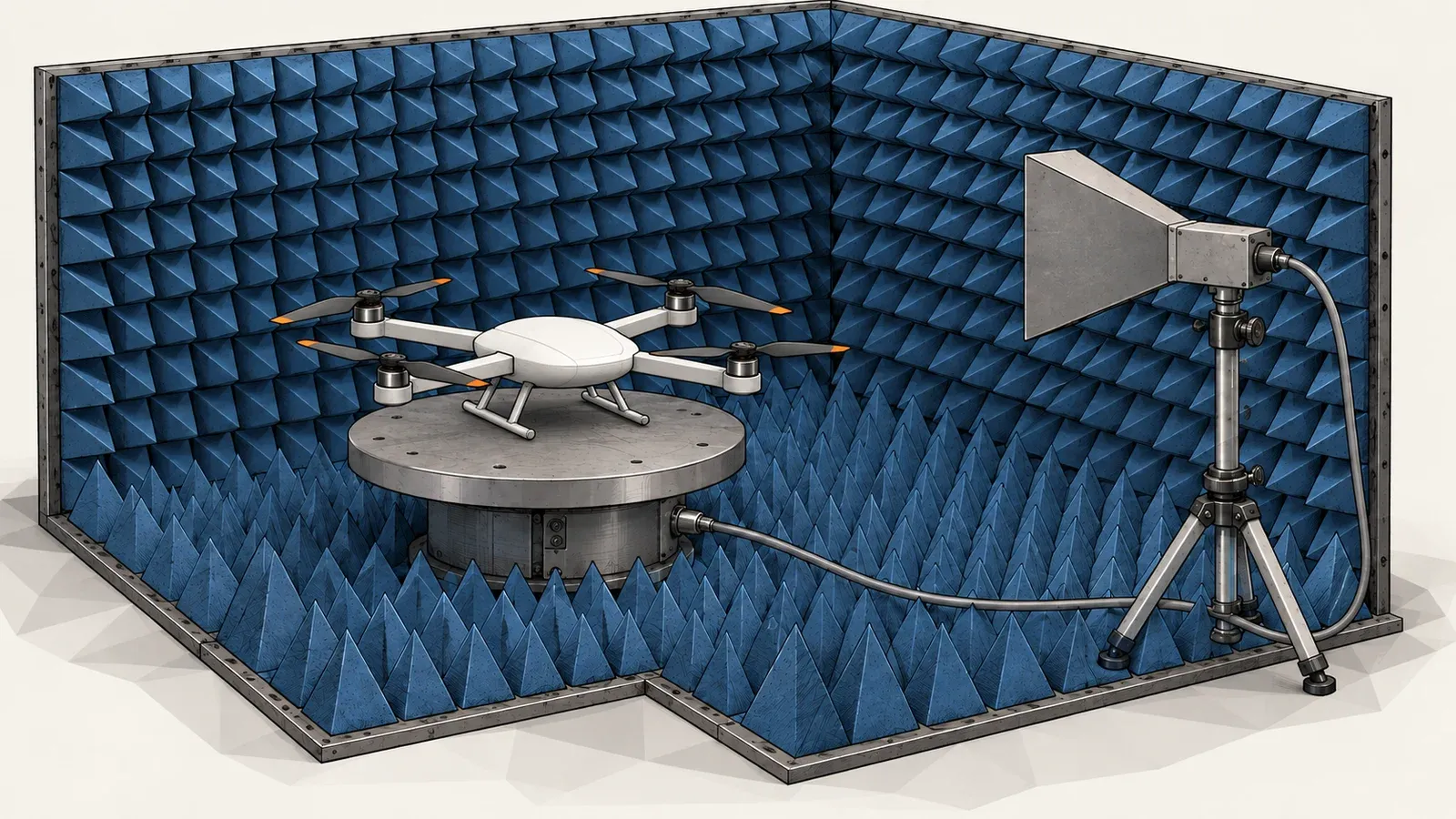
The Federal Communications Commission votes on 29 October on whether to stop recognising test labs in countries that do not recognise American ones. Its draft order, published on 8 October, says more than 82% of the testing behind US device approvals last year was done in a single such country: China.
Every drone, phone or other device with a radio needs FCC approval before it can be sold in the US. That approval rests on a report from an FCC-recognised test lab. From 1 December 2028, under the draft, the lab would have to be in the US or in one of 62 “Reciprocal Economies” listed in the draft, which have a mutual recognition agreement or a comparable trade deal with Washington.
Where the testing went
The FCC recognises 609 labs. A quarter are in China, 18% in Taiwan and 18% in the US, the draft says. China’s share of the actual testing rose from about 13% in 2007 to more than 82% in 2025. The US share fell below 4%.
Chairman Brendan Carr said officials in Washington had “looked the other way” for decades. His 2025 “bad labs” rule, aimed at labs owned or controlled by foreign adversaries, has already cost 29 labs their recognition. The FCC has also stripped two labs of recognition for copying test results between products and started proceedings against two more. All four are in Shenzhen or Dongguan, according to the draft.
Location, not ownership
The new rule looks at where the work happens, not who owns the lab. A European or American testing firm’s lab in Shenzhen is treated the same as a Chinese one. A lab based in a reciprocal country is caught too if it runs the measurements or writes the report in a non-reciprocal one.
Hong Kong is on the reciprocal list, through an Asia-Pacific agreement. India and Switzerland are among the countries that would not qualify. Existing approvals are untouched, and the rule applies only to applications received from 1 December 2028. Labs in China keep their recognition until 30 November 2028; the FCC says it will not strip any of them early because of the rule.
The drone case
Drones already face a stricter rule. Since December 2025, new foreign-made drones have been barred from approval through the Covered List. In August the FCC revoked the approvals of a drone and controller sold by Odyssey Robot of Pasadena, California, for falsely attesting that they were not foreign-made. Odyssey’s test reports showed the testing had been done at TÜV Rheinland’s Shenzhen lab.
Under the draft, a lab in Shenzhen could not test a drone, or anything else, for an FCC application from December 2028.
The bill
The FCC estimates the rule will add $79.3 million a year in testing costs, against $20.2 million a year of measurable benefit, mostly payments moving to American labs. The draft concedes that measured benefits alone do not cover the cost and argues that security does. The Consumer Technology Association had asked for at least three years to move testing, and the Information Technology Industry Council for three to five. The draft gives about 25 months.
The vote is at the same meeting that decides whether drones may use the 800 MHz mobile phone band. A draft can change before the commissioners vote.