
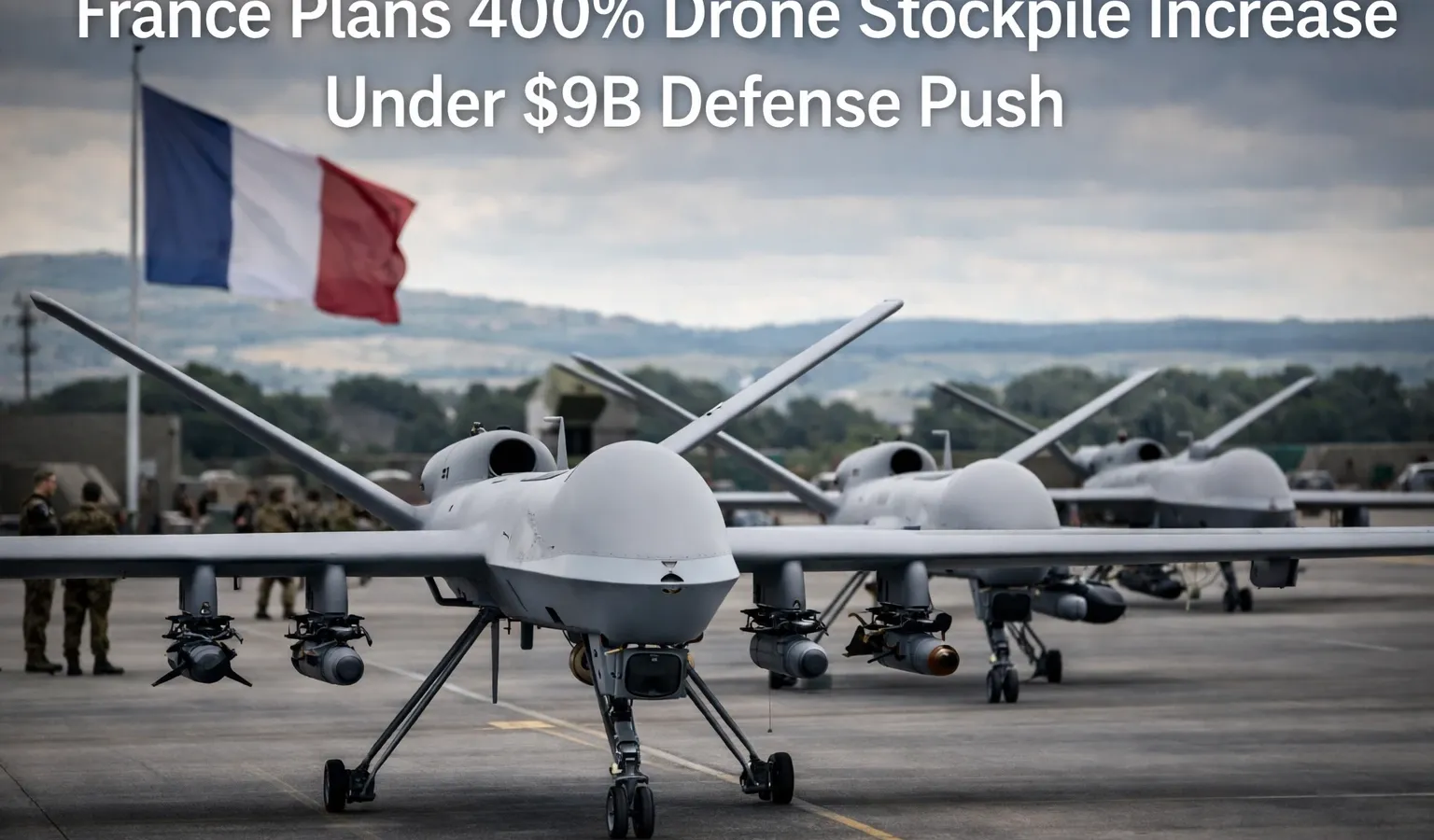
France plans to raise its stocks of explosive drones by up to 400% by 2030 under its updated military programming law. The law, promulgated on 16 August as Law 2026-791, adds €36 billion to defence spending to 2030.
That takes the 2024-2030 plan to €436 billion. The defence budget reaches €76.3 billion in 2030, or 2.5% of GDP, up from €57.1 billion in 2026.
Defence Minister Catherine Vautrin presented the bill on 8 April. As presented, it gave drones €8.4 billion to 2030, €2 billion more than before. Munitions got €8.5 billion more, which Prime Minister Sébastien Lecornu had announced in March.
The 400% applies to explosive drones, the kind that strike a target and are destroyed. The bill also planned 30% more surface-to-air missiles, 85% more SCALP cruise missiles and 230% more torpedoes. The actual stock levels are classified.
The Senate’s objection
The Senate passed the bill 297 to 33 on 9 June, after cutting the €36 billion, which the final text restored. Senators also added a national catalogue of trusted drones and counter-drone systems.
A Senate report on 7 July found about 90% of drone money going to a few large programmes. Only 28% of the drone payment credits for 2024 to 2026 had been used, it said. Of €15.1 billion in EU SAFE defence loans, €490 million was for drones.
The makers
MBDA said in March it would raise its missile output by 40% this year, double Aster production and invest €5 billion by 2030. Chief executive Eric Béranger announced it with the company’s results.
MBDA’s One-Way Effector is a cheap long-range attack drone built with car-industry methods. France ordered it first, with no quantity or value disclosed. MBDA says it could build up to 1,000 a month, with first deliveries reported for mid-2027.
At Eurosatory in June, France’s procurement agency, the DGA, chose the BLAZE interceptor drone from Latvia’s Origin Robotics, working with French integrator DSV, Janes reported.