
Hidden Level says it has received a $100 million Other Transaction Authority award to scale passive sensing for the counter-unmanned aircraft systems fight. The announcement describes the work as covering the company’s hardware, software and Airspace Monitoring Service across Department of War customers.
The important detail is the acquisition route. Hidden Level says military organizations can engage directly through the OTA to prototype, integrate, produce and deliver its technology at scale. That gives the company a mechanism for follow-on customer action beyond a single demonstration or site-level purchase. It does not mean the full $100 million has been obligated upfront, and the public announcement does not disclose the award’s ceiling, period of performance, task-order structure or planned quantities.
What the award covers
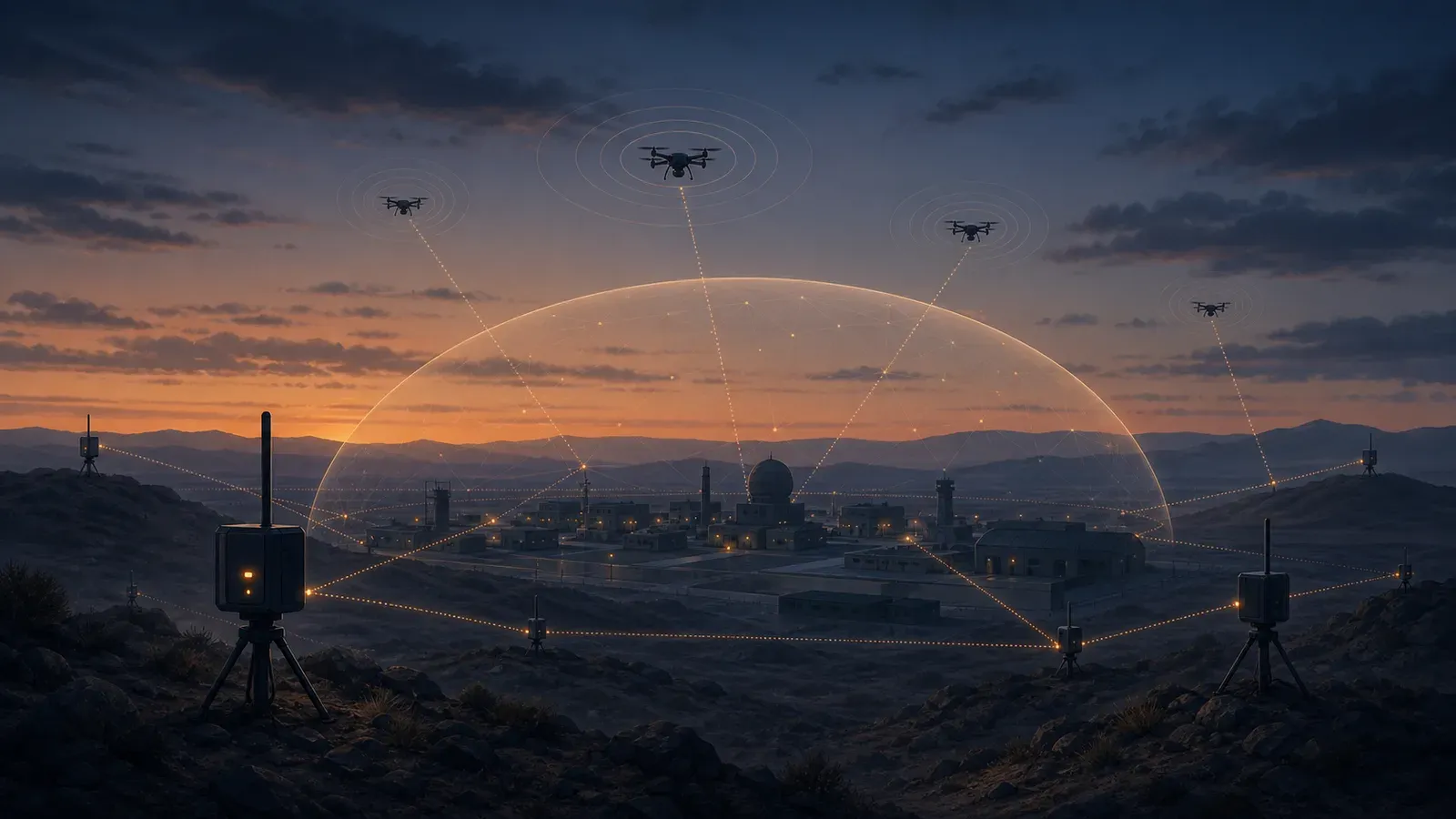
The announcement says Hidden Level will provide multi-function radio-frequency sensors intended to detect, track and identify crewed and uncrewed aircraft over military installations, test ranges and the U.S. border. The company describes its system as passive: it listens to radio-frequency activity rather than transmitting energy. It also says the package can connect with existing command-and-control systems.
Hidden Level names BREAKER, SURGE, BYOTx and its Airspace Monitoring Service among the products and services covered by its public materials. Those are company descriptions, not independent performance findings. The award announcement does not publish detection ranges, false-alarm rates, sensor counts or deployment schedules.
Why the vehicle matters
Counter-UAS programs are increasingly combining radar, radio-frequency sensing, electro-optical systems and defeat tools into layered defenses. A distributed passive network can add more observation points around a protected area while limiting the emissions associated with active radar. That is the operational logic behind the award, but the announcement does not establish how many sites will receive sensors or how the technology performed against competing systems.
The award follows Hidden Level’s participation in government-led evaluations including T-REX 25.2 and Falcon Peak 25.2, according to the company. Hidden Level was also named in a prior Department of War release for a $10 million APFIT project involving tactical passive radar for small-UAS detection and tracking. Those records show a progression from evaluation and prototype work toward a broader buying pathway; they do not prove that department-wide fielding has already begun.
What remains unknown
The next meaningful milestone is not the headline value but evidence of execution: a funded order, a named customer deployment, published test results or a transition into a formal program of record. Until those details appear, the $100 million should be read as the value stated for an acquisition vehicle with potential to support scaled purchases—not as guaranteed Hidden Level revenue.