
Taiwan’s defence ministry has opened a NT$35.97 billion tender for vertical take-off drones for its navy, about US$1.1 billion. The notice went up on the government procurement system on 16 November, and bids close on 15 December.
It is the largest call on FlightBrief’s list of open drone tenders by some distance. The ministry’s procurement office runs it on behalf of Navy Command and lists the item only as “smart vertical take-off and landing drones”. It names no aircraft and no maker.
What the money buys
The numbers behind the budget sit in the defence ministry’s spending plan for 2027, sent to the Legislative Yuan on 31 August. As reported by the Liberty Times, the programme runs from 2026 to 2029 and costs NT$36.0 billion in all.
It buys 280 drones, 140 control systems and 82 transport vehicles. The navy plans 40 drones this year and 110 in 2027, with NT$13.77 billion set aside for 2027 alone. The last 130 follow in 2028 and 2029.
The plan gives the reason in plain terms. If China’s opening strikes knock out Taiwan’s command and communications, the navy wants drones that keep watching the sea and resist GPS jamming. They go to its surface combat groups and its littoral forces.
One aircraft in the frame
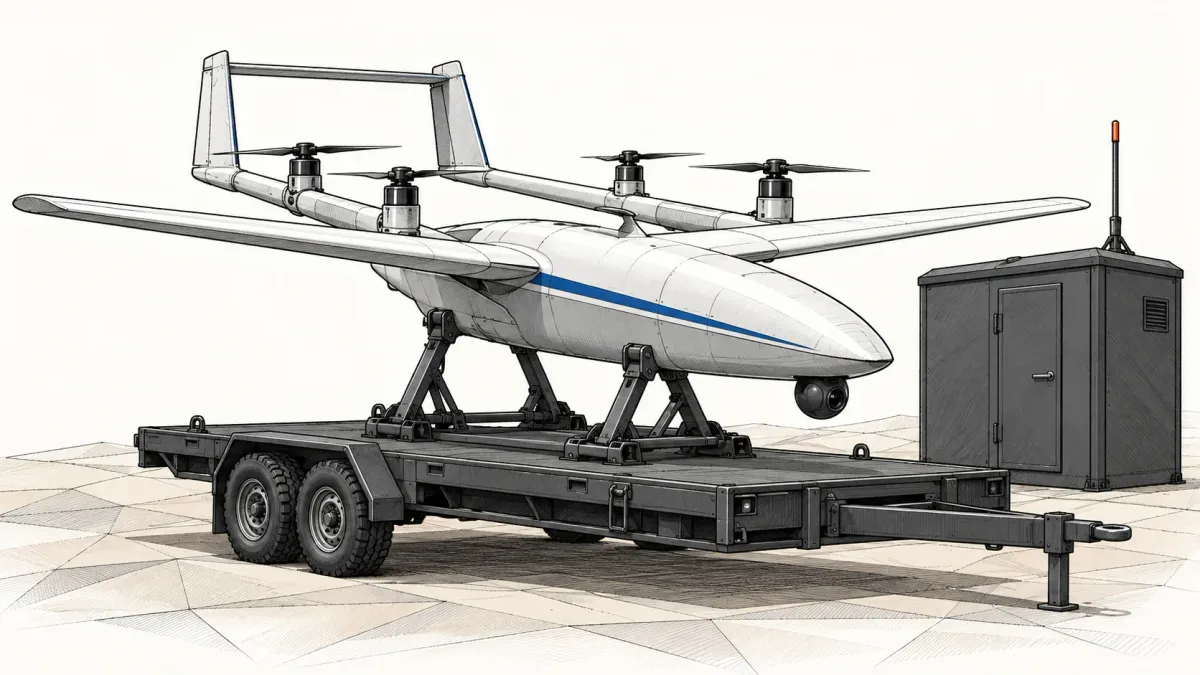
The tender is open to any qualified firm. When the budget went to the legislature in August, though, United Daily News described the 280 drones as V-BATs, the tail-sitting drone made by the American company Shield AI. The Liberty Times noted that outside attention had focused on the V-BAT, and that the notice does not specify one.
Shield AI already flies in Taiwan. On 13 October it said it had delivered the coast guard’s first V-BAT with Taiwan’s AIDC, under a contract won in July.
The rules favour a maker with a track record. Bidders must prove they have already built or supplied similar equipment, with acceptance records or invoices; a contract alone does not count. Each puts up a NT$50 million bond.
The ministry will choose the most advantageous bid rather than the cheapest, and price counts for at least 20% of the score. Only one firm wins. The purchase is marked as touching national security, and it sits outside Taiwan’s commitments under the WTO’s procurement agreement, so no foreign bidder has a treaty right to compete.
Beside the coast guard’s buy
The scale shows next to the coast guard’s own drone programme. Its officials told legislators in April that it would spend about NT$2.1 billion on 451 vertical take-off drones, Taiwanese papers reported. Its tender for the 18 medium-range drones in that plan, worth NT$782.7 million, closes on 25 November.
The navy is also buying a domestic drone in the same budget. United Daily News reported NT$16.79 billion for 32 Albatross II drones from the National Chung-Shan Institute of Science and Technology, Taiwan’s state weapons laboratory.
The bids for the 280 drones will be opened at the defence ministry in Taipei at 10:00 on 15 December. Unless at least three qualified firms have bid, the ministry will not open them.