Freefly Astro Max
A US-built, Blue UAS-listed mapping and inspection quadcopter with open payloads and Auterion software, priced well above the DJI aircraft it replaces for buyers who can no longer buy DJI.
- Weight
- 3,523 g empty; 8,700 g max takeoff
- Flight time
- 39 min without payload
- Price
- $28,995
- Made by
- Freefly Systems
Where to buyFreefly store, $28,995 NDAA/Blue; dealers
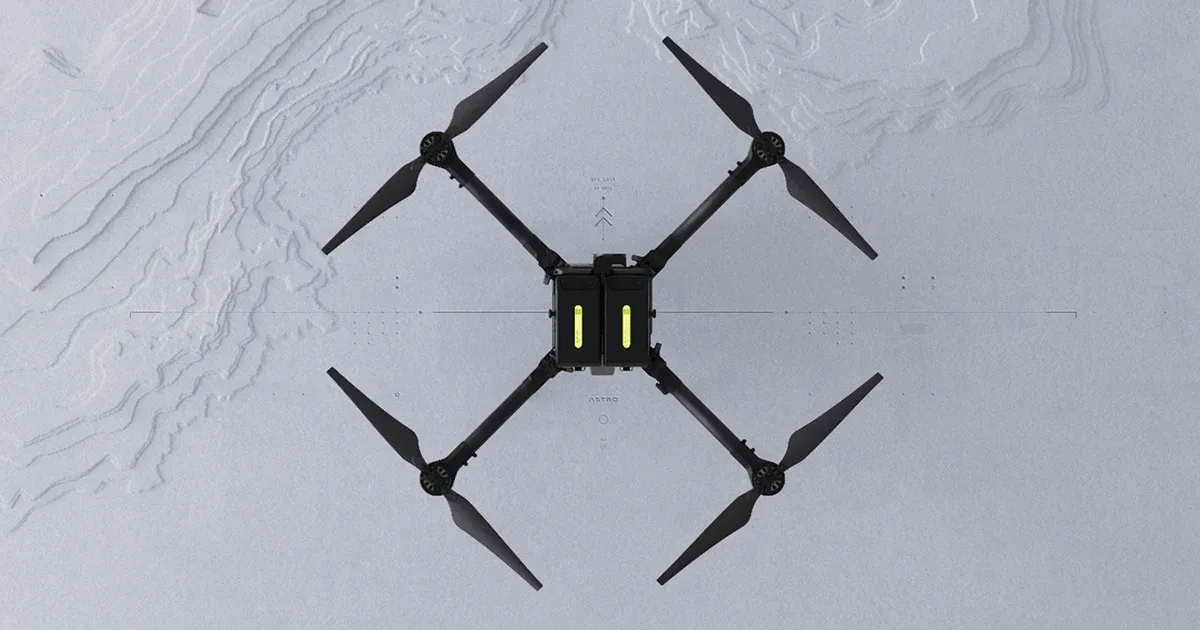
The Freefly Astro Max is a folding enterprise quadcopter for mapping, surveying and inspection, built by Freefly Systems in Woodinville, Washington. It is on the Pentagon’s Blue UAS list and NDAA compliant, which is why it is bought: it is one of the few US-made aircraft in its class that federal agencies and many state buyers can still purchase. It runs Auterion’s software on a Skynode flight computer, and takes a range of third-party cameras and sensors.
Freefly sells two versions. The NDAA/Blue build costs $28,995 on its store and the standard build $22,995; its mapping bundle costs $43,725 in the NDAA/Blue version.
Specifications
| Specification | Freefly Astro Max |
|---|---|
| Empty weight | 3,523 g |
| Maximum takeoff weight | 8,700 g (depends on altitude) |
| Maximum payload | 3,000 g |
| Flight time | 39 minutes without payload |
| Diameter, unfolded | 930 mm without props, 1,407 mm with props |
| Folded | 508 mm diameter, 178 mm high |
| Propellers | 22 x 7.0 in, folding; four Freefly 7010 motors |
| Battery | Freefly SL8-Air, 157 Wh, 6S, 1,035 g each |
| Flight computer | Freefly Skynode with Auterion Enterprise PX4 |
| Satellite navigation | GPS L1/L2, GLONASS, BeiDou, Galileo |
| Connectivity | Bluetooth, Wi-Fi, USB-C, LTE (North America) |
| Operating temperature | −20 °C to 50 °C |
| Ingress protection | IP43 |
All figures are Freefly’s published specifications, checked against the manufacturer’s specification page on 28 September 2026. FlightBrief has not flown the aircraft.
Two flight times. The specification sheet gives 39 minutes with no payload. Freefly’s product page gives 28 minutes, without saying for which payload. Expect a working flight with a camera to be nearer the lower figure. Freefly does not publish a maximum speed, a wind limit or a radio range, and none are asserted here.
Payloads
Freefly’s own camera is the LR1, built around a 61 MP Sony sensor with lenses from 24 mm to 75 mm; it costs $8,745, with thermal and laser rangefinder upgrades sold separately. The product page lists more than 16 compatible payloads, including lidar, multispectral and thermal sensors from other makers.
Use Cases
Survey and mapping work where the client or the funding requires an NDAA-compliant aircraft: federal agencies, state departments of transportation, utilities with federal contracts. Infrastructure inspection with a thermal or zoom payload. Research and agriculture work with multispectral sensors, where the open payload system matters more than the price.
Market Context
The Astro Max competes on eligibility more than specification. Against the DJI Matrice 350 RTK, it is a little lighter at maximum takeoff (8.7 kg against 9.2 kg), flies for less time without payload (39 minutes against 55) and costs more than twice as much. Its advantage is that it can be bought by customers who can no longer buy DJI. See the Blue UAS Cleared List guide for how that works.
The Skydio X10 is the other US-made aircraft in most government shortlists. The difference is the design choice: the X10 is a closed, autonomous inspection aircraft with its own cameras, while the Astro Max is an open airframe that carries whatever sensor the job needs.
Compared
| Specification | Freefly Astro Max | Skydio X10 | DJI Matrice 350 RTK |
|---|---|---|---|
| Weight | 3,523 g empty; 8,700 g max takeoff | 2.11 kg (4.65 lb) | 9.2 kg max takeoff |
| Flight time | 39 min without payload | up to 40 min | 55 min without payload |
| Price | $28,995 | On request | On request |
| Where to buy | Freefly store, $28,995 NDAA/Blue; dealers | Skydio direct and resellers; price on quote | Discontinued in the US; remaining dealer stock |
| Launched | — | Feb 28, 2024 | May 9, 2023 |
Figures are the manufacturers' published specifications, as on each product's page.