
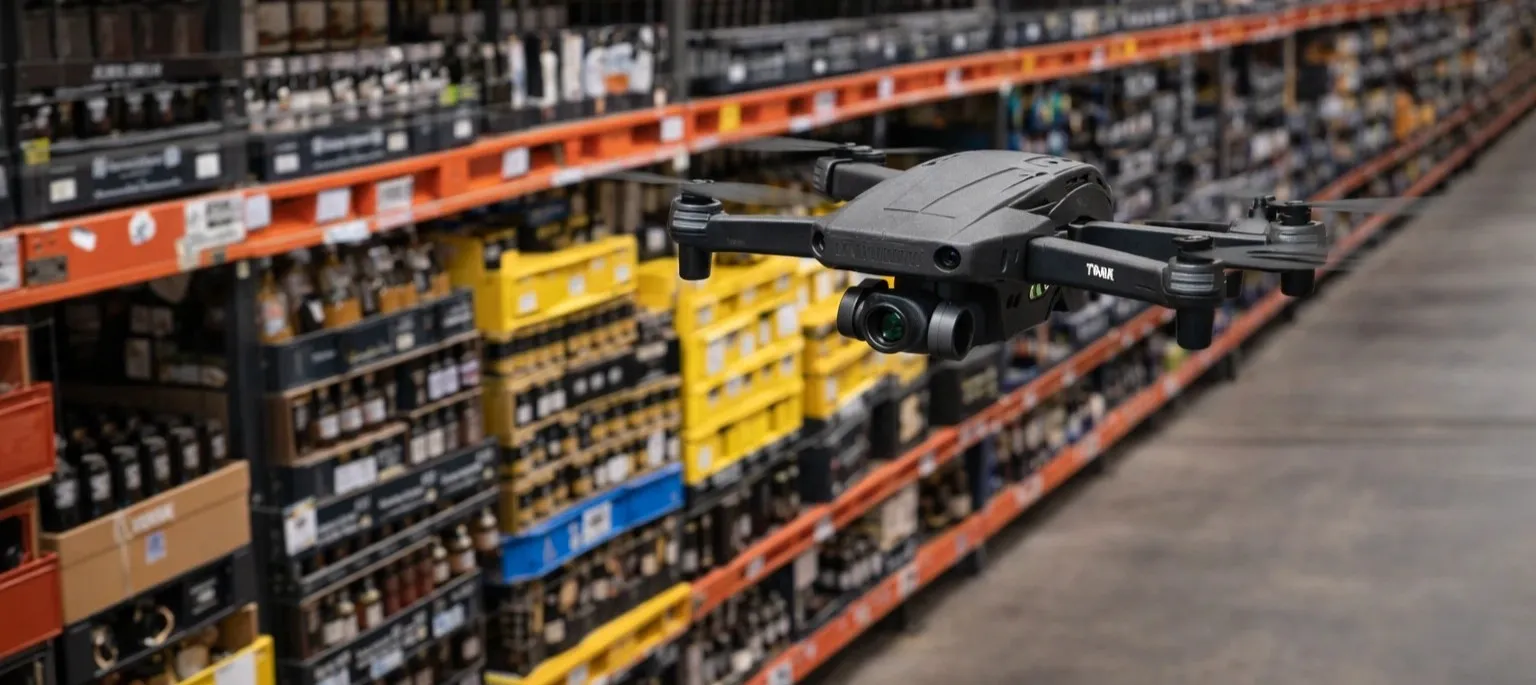
Corvus Robotics has deployed more than 40 autonomous inventory drones across nine Southern Glazer’s distribution centers over the past 18 months — and the numbers are specific enough to matter. The system has completed roughly 5,000 flights, flagged over 35,000 verified inventory discrepancies, and is saving each site an estimated 60 to 70 hours of manual labor per week.
Southern Glazer’s is the largest wine and spirits distributor in the US, operating across 47 markets. At that scale, inventory accuracy isn’t an operational nicety — a misplaced pallet represents real revenue, and errors that compound across a high-SKU, fast-moving supply chain are expensive to unwind.
What the Corvus One Actually Does
The Corvus One flies continuously through active warehouse aisles without requiring facility shutdowns or pausing floor operations. It scans reserve storage locations, captures high-resolution images and barcode reads, and logs historical video tied to specific pallet positions. When it finds a discrepancy, it flags it with enough supporting data that staff can resolve the issue directly rather than spending time locating it first.
The operational shift this enables is meaningful. Southern Glazer’s has moved from quarterly inventory counts to validation every two weeks. Cycle counting frequency is one of the clearest leading indicators of inventory control maturity — quarterly counts mean errors have weeks to propagate before anyone catches them.
The Productivity Number That Stands Out
A 100-basis-point improvement in cases processed per hour is the figure Southern Glazer’s is citing, and it’s worth unpacking. In distribution, throughput per hour is a composite metric — it reflects pick accuracy, inventory availability, and labor efficiency simultaneously. Moving that number by a full percentage point across a nine-facility network suggests the drone system is doing something more than catching the occasional miscount.
The labor reallocation piece is also significant. Saving 60 to 70 hours per site per week doesn’t mean headcount reductions — it means those hours are redirected from walking aisles with handheld scanners to resolving confirmed issues using drone-generated data. The work becomes higher-value.
Why This Deployment Model Is Different
Corvus Robotics CEO Jackie Wu has been explicit that this is infrastructure, not a pilot. That framing matters. Warehouse drone pilots are common; most never reach full deployment because the operational integration is harder than the hardware. Southern Glazer’s running 40+ drones across nine sites with shared best practices and standardized deployment models is a different category of commitment.
For food and beverage distribution — where SKU counts are high, inventory turns are fast, and margin is thin — the economics of always-on autonomous scanning start to look less like automation investment and more like table stakes. The question for the rest of the industry is how quickly that expectation spreads.