
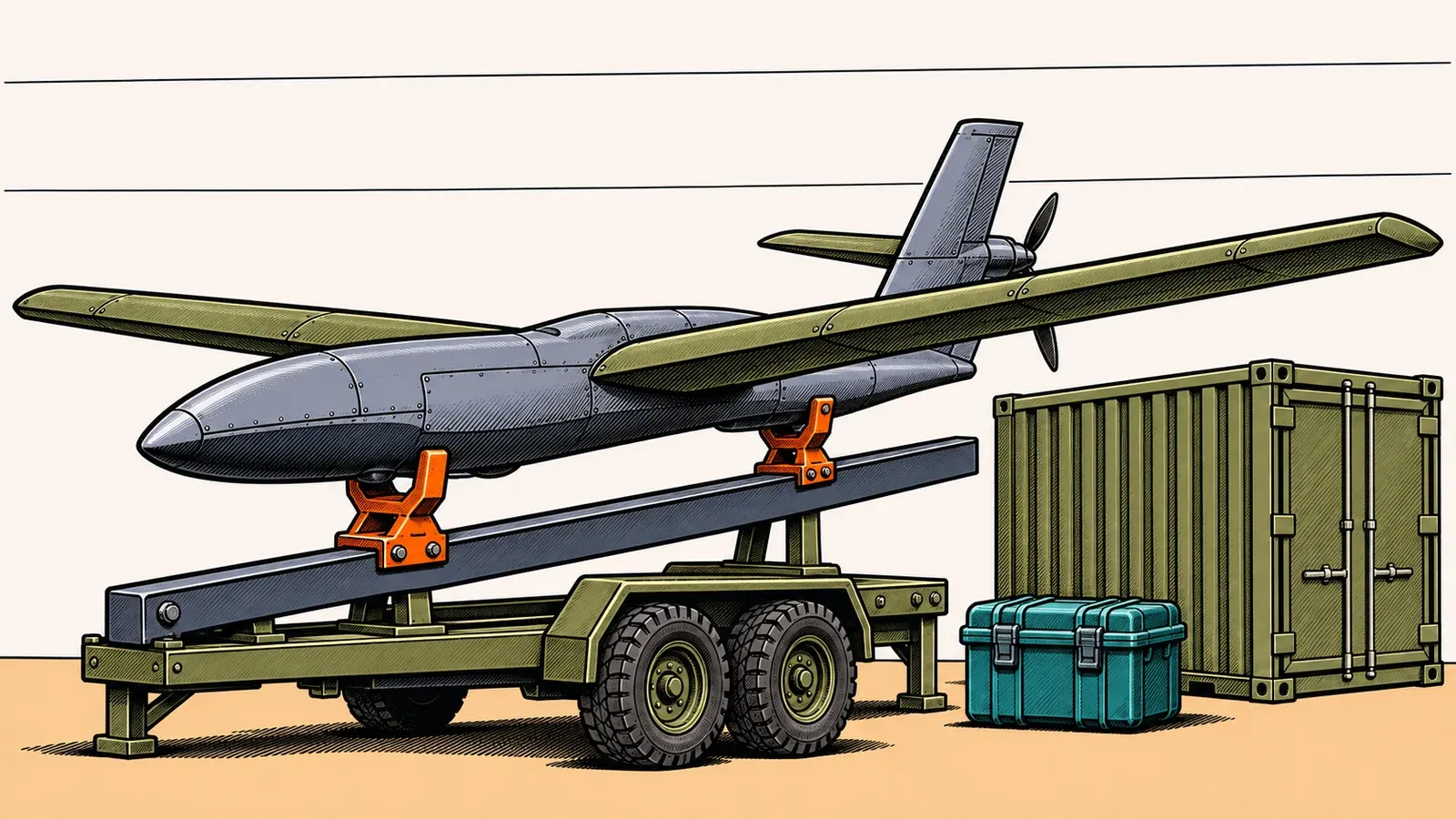
The Pentagon will pay up to $130,000 for a one-way attack drone that flies 20 to 600 nautical miles, and up to $250,000 for one that flies further. The ceilings are in a new Defense Innovation Unit prize challenge, Extended Range Strike Gauntlet II, which closes for entries on 7 December.
The Pentagon has budgeted up to $500 million for the challenge and the orders that follow it, the solicitation says. Every company that flies all the test cards at the demonstration in mid-March 2027 receives $500,000. The best are offered prototype agreements, then production orders.
What it wants
There are two tiers. A medium-range drone must carry at least 7 pounds; a long-range one at least 25 pounds, with more than 100 “strongly preferred”. Both are launched from the surface, must navigate when GPS is jammed, and must find and track targets with on-board recognition software and finish the attack without an operator steering it.
The yardstick is not the sticker price. DIU will rank entries by cost per effect: the fully burdened unit cost, with launcher, ground station and software licences included, divided by the share of missions that succeed. The ceilings are $300,000 per effect for the medium tier and $500,000 for the long one.
Speed counts as much as price. Entrants must be able to deliver 20 to 30 systems by June 2027 and more than 100 within six to eight months of the solicitation, and show a path to building 100 a month within six months.
A different price bracket
The challenge runs under the Pentagon’s Drone Dominance initiative, which has so far bought short-range drones by the tens of thousands. Neros said its order from that programme’s second round was 14,000 drones “valued at over $100 million”, a little over $7,000 a drone by FlightBrief’s arithmetic. The reusable bomber drones the programme tested in October were priced at $20,000.
A medium-range strike drone at the cap costs what 18 of Neros’s drones cost, at most. What the money buys is distance. The solicitation calls 20 to 100 nautical miles typical for the medium tier; the short-range programme’s deep-strike mission was flown at 15 kilometres.
Who can enter
The challenge is open to US and international companies, alone or in partnership, but only with complete systems: components and subsystems will not be evaluated. Foreign firms register with a NATO supplier code and on SAM.gov, and carry all the travel, shipping, visa and export work themselves. Combat use is “of particular interest” but not required.
The first round, called Ground-Based Affordable Mass, ended in mid-November. Companies that won prototype agreements from it are invited straight into Gauntlet II; DIU has not published their names. Everyone else, including that round’s other entrants, has to apply again.
Entrants must also meet supply-chain rules that are still being written. DIU says a framework for this challenge, modelled on the short-range programme’s of 23 July, will be released in December, and that compliance is required for an award.
A third round is planned to start in mid-August 2027, with its solicitation due in April.