
DJI Avata 360
The first FPV drone with a native 360° camera and the first with omnidirectional obstacle sensing. At 455 g it lives outside every sub-250 g exemption, and 23 minutes is what you get.
- Rating
- 4.3/ 5
- Weight
- 455 g
- Flight time
- 23 min
- Price
- $719
- Launched
- Mar 26, 2026
- Made by
- DJI
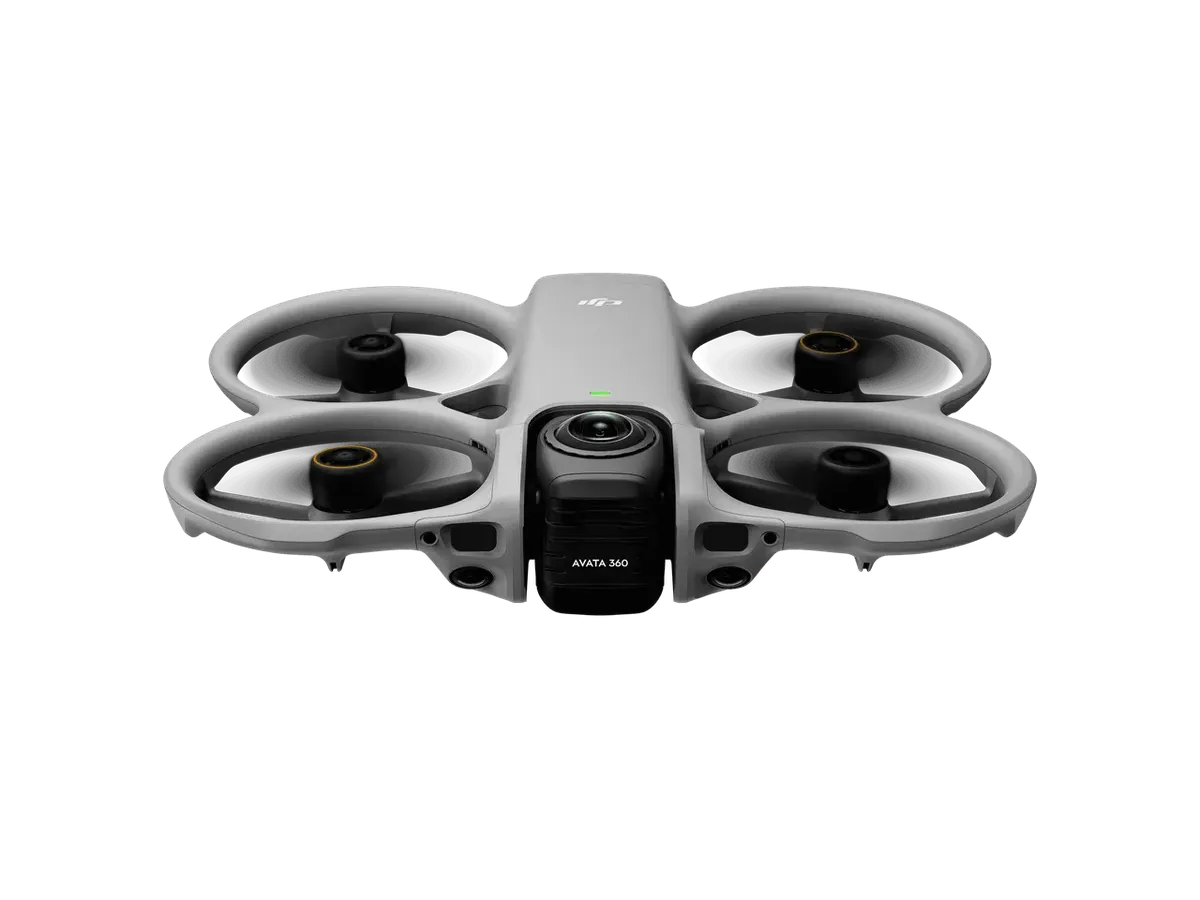
The DJI Avata 360 is a 455 g ducted FPV drone with two 64 MP 1/1.1-inch sensors that record 8K 360° video at 60 fps, launched on 26 March 2026 as the successor to the Avata 2. There is no Avata 3, whatever the rumour sites said; this is the next one. It is the first drone to combine a native 360° camera with full FPV flight, and the first FPV aircraft DJI has fitted with omnidirectional obstacle sensing.
It went on sale in the United States on 13 April 2026 at $719 for the aircraft alone and $979 for the Fly More Combo with the RC 2 screen controller. Bundles with the RC Motion 3 and Goggles N3 were sold in Europe from launch and were not initially available in the US.
Aircraft Specifications
| Specification | DJI Avata 360 |
|---|---|
| Takeoff weight | Approx. 455 g |
| Dimensions | 246 × 199 × 55.5 mm |
| Max flight time | Approx. 23 min |
| Max horizontal speed | 6 m/s in Cine mode; 12 m/s in Normal, adjustable to 16 m/s; 18 m/s in Sport |
| Max wind resistance | 10.7 m/s (Level 5) |
| Max takeoff altitude | 4,500 m |
| Operating temperature | -10° to 40°C |
| Obstacle sensing | Omnidirectional vision, plus forward-facing LiDAR |
| Internal storage | 42 GB |
| Airframe | Ducted propellers |
All figures are DJI’s published specifications. FlightBrief has not flown the aircraft.
The ducts are the Avata line’s defining feature: contact with a wall or a branch that would end a conventional quadcopter’s flight is survivable, which is why the aircraft is flown indoors and close to things.
Camera
| Specification | Value |
|---|---|
| Sensors | Two 1/1.1-inch square CMOS, 64 MP each |
| 360° video | 8K 7680 × 3840 (2:1) at up to 60 fps; 6K 6000 × 3000 at up to 60 fps |
| Single-lens video | 4K 3840 × 2160 at up to 60 fps |
| Max bitrate | 180 Mbps |
The 360° capture is the reason to buy this over the Avata 2. The whole sphere is recorded and the shot is framed afterwards, so a pilot concentrating on flying a gap does not also have to point a camera.
Transmission, Control and Battery
| Specification | Value |
|---|---|
| System | DJI O4+ |
| Max range | 20 km (FCC), 10 km (CE) |
| Controllers | RC 2, RC-N2 or RC-N3; or Goggles 3 or N3 with the RC Motion 3 or FPV Remote Controller 3 |
| Battery | 2,700 mAh or more, 38.67 Wh or more |
| Charging | Approx. 47 min from empty in the charging hub |
The goggles are the point of an FPV drone and the pricing rewards buying them: in Europe the Motion Fly More Combo with Goggles N3 and RC Motion 3 costs the same €939 as the Fly More Combo with the RC 2 screen controller.
Use Cases
FPV flying for people who want the immersive view without building an aircraft. Real estate and venue fly-throughs where the ducts allow flight through doorways and the 360° capture lets the shot be reframed later. Action sports and travel creators who want to fly first and edit the framing afterwards.
Market Context
At 455 g the Avata 360 needs registration in the US, the EU and the UK, and in Europe it sits well outside the C0 class. Anyone who wants 360° capture under 250 g is looking at the Antigravity A1, which is not an FPV aircraft and costs more than twice as much.
Against the Avata 2, which DJI still sells at 377 g, the 360 adds true omnidirectional sensing, the second sensor and 8K, and weighs 78 g more. Against the Mini 5 Pro it is a different tool: the Mini is a camera that flies, the Avata is an aircraft with a camera.
DJI’s US position applies here as everywhere. The company is on the FCC Covered List, which blocks new equipment authorisations and excludes DJI from federal procurement. The Avata 360 nonetheless reached US sale in April 2026, less than three weeks after the global launch, and a consumer FPV drone is untouched by the procurement exclusion. The best personal drone guide names it best FPV drone for 2026, with the caveat that FPV has a learning curve no software removes.
Compared
| Specification | DJI Avata 360 | Antigravity A1 | DJI Neo 2 |
|---|---|---|---|
| Weight | 455 g | 249 g (291 g with the high-capacity battery) | 151 g |
| Flight time | 23 min | 24 min (39 min high-capacity) | 19 min |
| Price | $719 | $1,599 | $259 |
| Where to buy | Amazon; DJI store, US sale since April 2026 | Antigravity store and retailers; US stock | Amazon; DJI store |
| Launched | Mar 26, 2026 | Dec 4, 2025 | Nov 13, 2025 |
Figures are the manufacturers' published specifications, as on each product's page.
Coverage
When you buy through links on this page we may earn an affiliate commission. As an Amazon Associate FlightBrief earns from qualifying purchases. It costs you nothing extra, and it does not influence our editorial assessment — see our editorial policy.