

DJI Mini 5 Pro
The first sub-250 g drone with a 1-inch sensor, and the best consumer drone you can buy in 2026 if you live somewhere DJI will sell it to you.
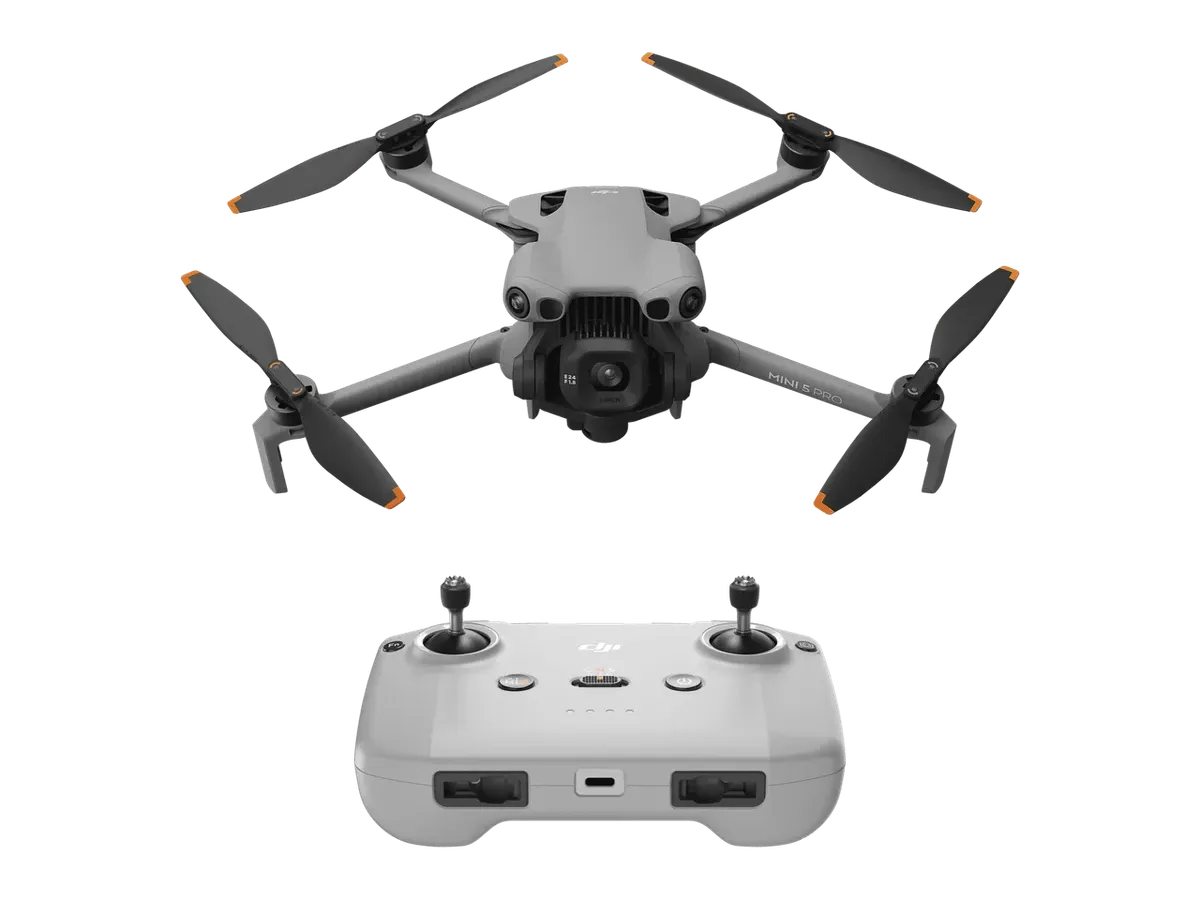
- Rating
- 4.8/ 5
- Weight
- 249.9 g
- Flight time
- 36 min (52 min Plus)
- Price
- Not sold in US
- Launched
- Sep 17, 2025
- Made by
- DJI
The DJI Mini 5 Pro is a folding consumer drone with a takeoff weight of 249.9 g and a 1-inch camera sensor, a combination no other drone had managed when it went on sale in September 2025. Everything under 250 g had until then meant accepting a small sensor and the noise that comes with it. The Mini 5 Pro removes that trade-off and adds a forward-facing LiDAR unit that most drones at twice the price do not carry.
DJI does not sell it in the United States. The company gave it no US product page, and the aircraft has no FCC equipment authorisation of its own after DJI was added to the FCC Covered List in December 2025. Units reaching American buyers arrive through third-party sellers, and a buyer in the US should read the market section below before paying flagship money.
Aircraft Specifications
| Specification | DJI Mini 5 Pro |
|---|---|
| Takeoff weight | 249.9 g (standard battery) |
| Folded dimensions | 157 × 95 × 68 mm |
| Unfolded dimensions | 304 × 380 × 91 mm |
| Max flight time | 36 min (standard battery), 52 min (Intelligent Flight Battery Plus) |
| Max horizontal speed | 19 m/s in S mode with the Plus battery |
| Max ascent / descent speed | 10 m/s / 8 m/s in S mode |
| Max wind resistance | 12 m/s |
| Max service ceiling | 6,000 m (standard battery), 4,500 m (Plus battery) |
| Operating temperature | -10° to 40°C |
| Obstacle sensing | Omnidirectional binocular vision, plus forward-facing LiDAR |
| Internal storage | 42 GB |
All figures are DJI’s published specifications. FlightBrief has not flown the aircraft.
Battery
| Specification | Standard | Plus |
|---|---|---|
| Capacity | 2,788 mAh | 4,680 mAh |
| Max flight time | 36 min | 52 min |
| Charging time in the aircraft | 69 min | 94 min |
The Plus battery is the catch. In DJI’s own words, an aircraft fitted with it “exceeds the C0 MTOM threshold and can no longer be operated as a C0 UAS within the EU.” The 52-minute drone and the sub-250 g drone are not the same aircraft. In Europe you choose one, and the Plus battery is not sold there.
Camera
| Specification | Value |
|---|---|
| Sensor | 1-inch CMOS, 50 MP effective |
| Lens | 24 mm equivalent, f/1.8, 84° FOV |
| Max photo resolution | 8192 × 6144 |
| Video | 4K 3840 × 2160 at 24/25/30/48/50/60/120 fps |
| Slow motion | 1080p at 240 fps |
| Max bitrate | 130 Mbps |
| Codecs | H.264, H.265 |
The sensor is the same size as the one in the Air 3S’s main camera, in an aircraft that weighs a third as much.
Transmission and Obstacle Sensing
| Specification | Value |
|---|---|
| System | DJI O4+ |
| Max range | 20 km (FCC), 10 km (CE) |
| Sensing | Omnidirectional vision plus forward LiDAR |
The LiDAR is what separates the Mini 5 Pro from the Mini 4 Pro in practice: vision-only sensing degrades in low light, and the LiDAR keeps the forward sensing working at dusk and in dim interiors.
Use Cases
Travel and landscape photography where the 250 g threshold avoids registration for recreational flying in Canada and the US, though not in the EU, the UK or Japan. Real estate and small commercial jobs where a 1-inch sensor was previously the reason to carry a heavier aircraft. Anyone upgrading from a Mini 3 or Mini 4 Pro who wants better low-light output without leaving the weight class.
Market Context
In Europe and most of the rest of the world the Mini 5 Pro is the drone to buy in this class, and the best personal drone guide ranks it first for that reason. The Mini 4 Pro is the same idea one generation back and is the pick in the United States, where it holds an FCC authorisation from before the December 2025 listing and DJI still sells it.
The US position is the awkward part. DJI’s addition to the FCC Covered List blocks new equipment authorisations, which is why there is no US launch. Third-party listings exist, prices vary by seller, and the buyer carries the warranty and support risk. The FCC’s separate proposal to bar the import and marketing of foreign “military-grade” drones does not reach this aircraft, which carries no thermal camera and weighs under 55 lb, but the comment record on that proposal shows how fluid the position is.
The nearest non-DJI alternative under 250 g is the Potensic ATOM 3, at roughly half the price with a smaller sensor and no obstacle avoidance; it too is blocked from US sale. The Potensic ATOM 2 is the one that can still be bought in America.
Compared
| Specification | DJI Mini 5 Pro | DJI Mini 4 Pro | Potensic ATOM 2 |
|---|---|---|---|
| Weight | 249.9 g | under 249 g (over with the Plus battery) | under 249 g |
| Flight time | 36 min (52 min Plus) | 34 min (45 min Plus) | 32 min |
| Price | Not sold in US | $759 | $330 |
| Where to buy | Not sold by DJI in the US; third-party sellers | Out of stock at DJI's US store (29 Sept 2026); Amazon sellers | Amazon |
| Launched | Sep 17, 2025 | Sep 25, 2023 | Feb 18, 2025 |
Figures are the manufacturers' published specifications, as on each product's page.
Coverage
When you buy through links on this page we may earn an affiliate commission. As an Amazon Associate FlightBrief earns from qualifying purchases. It costs you nothing extra, and it does not influence our editorial assessment — see our editorial policy.