HoverAir X1 PROMAX
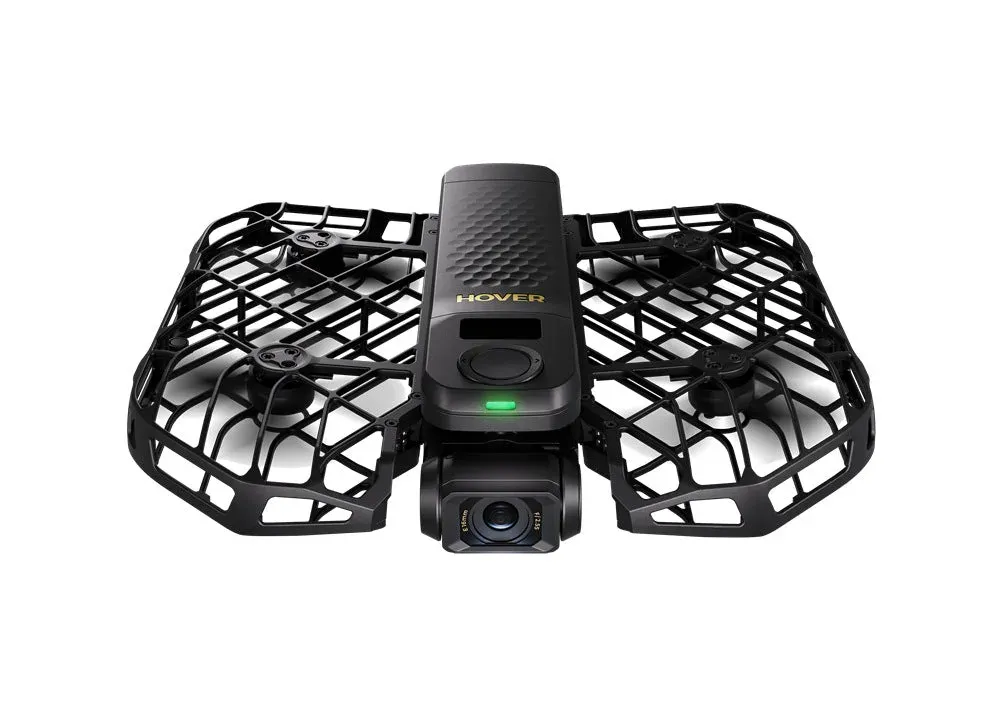
A flying camera rather than a drone: it follows you, films you in 8K and needs no piloting. Sixteen minutes and rear-only sensing are the price of the 192 g frame.
- Rating
- 4.1/ 5
- Weight
- 192 g
- Flight time
- 16 min
- Price
- $699
- Launched
- Aug 26, 2024
- Made by
- HoverAir (Zero Zero Robotics)
The HoverAir X1 PROMAX is a 192 g folding self-flying camera that launches from your palm, tracks you at up to 42 km/h and records 8K video, with no controller in the box and no piloting required. It is the top of HoverAir’s X1 range, above the 4K X1 PRO at $499 and the 2.7K X1 at $299, and it lists at $699. It launched on Indiegogo on 26 August 2024 and went on general sale that November.
HoverAir is the consumer brand of Zero Zero Robotics, a Beijing company. The X1 series is the product a lot of people wanted from drones all along — a camera that follows them — and its buyers are mostly cyclists, skiers, runners and creators who have no interest in learning to fly.
Aircraft Specifications
| Specification | HoverAir X1 PROMAX |
|---|---|
| Weight | 192 g with battery; 193.1 g max takeoff with an ND filter |
| Folded dimensions | 4.13 × 5.87 × 1.34 in |
| Unfolded dimensions | 6.81 × 5.87 × 1.54 in |
| Max flight time | 16 min |
| Max horizontal speed | 11.7 m/s (42 km/h) |
| Max ascent / descent speed | 3 m/s |
| Max wind resistance | Level 5, up to 10.7 m/s |
| Max takeoff altitude | 5,500 m |
| Max flight height | 120 m, subject to local rules |
| Operating temperature | -10° to 45°C |
| Obstacle sensing | Rear time-of-flight and rear vision sensor; downward vision positioning |
| EU class | C0 |
| Waterproof | No |
All figures are HoverAir’s published specifications. FlightBrief has not flown the aircraft.
The sensing looks backwards, because the aircraft is usually behind you. It has nothing forward-facing, so a follow shot into a tree line is the pilot’s problem, except that there is no pilot.
Camera
| Specification | Value |
|---|---|
| Sensor | 1/1.3-inch |
| Lens | 16 mm equivalent, f/2.55, 107° FOV, fixed focus |
| ISO | 100–12800 |
| Max photo | 48 MP, JPEG and 10-bit DNG |
| Video | 8K 7680 × 4320 at 24/25/30 fps; 4K at up to 120 fps; 1080p at up to 120 fps |
| Vertical video | 4K at up to 60 fps |
| Colour | Standard, HDR, HLG and H-Log, the last two 10-bit |
| Max bitrate | 160 Mbps at 8K/30 |
| Stabilisation | Two-axis mechanical gimbal (tilt, roll) plus electronic stabilisation and horizon levelling |
The X1 PRO uses a 1/2-inch sensor, tops out at 4K/60, has no 10-bit colour and only 12 MP stills. Those are the $200.
Control, Battery and Storage
| Specification | Value |
|---|---|
| Control | Phone app over Wi-Fi 6; optional Beacon and joysticks, up to 1 km |
| Battery | 1,920 mAh, 14.17 Wh, 62 g |
| Charging | 45 min for one battery in the hub; 55 min in the aircraft |
| Internal storage | 64 GB, plus microSD |
| Return to home | Yes |
A 65 W charger is needed for the quoted charging times.
Use Cases
Solo athletes who want a following camera: cycling, skiing, running, paddle sports, with dedicated modes for each. Creators who want drone-style footage of themselves without a second person or a controller. Travellers who want a 192 g camera that fits in a jacket pocket and takes off from a hand.
Market Context
The X1 PROMAX is not competing with the DJI Mini 5 Pro and should not be bought as if it were. A Mini flies for 36 minutes, sees in every direction and goes 20 km away; the PROMAX flies for 16, sees behind, and stays within a kilometre of its phone. What it does that a Mini does not is follow a moving subject at 42 km/h with nobody flying it, and fold small enough to carry every day.
DJI’s answer is the Neo 2, a 151 g self-flying camera with omnidirectional sensing and 4K/100, which is the alternative to weigh if piloting-free capture is the point and 8K is not. The Antigravity A1 is the alternative for 360° capture in a sub-250 g frame at more than twice the price.
The best personal drone guide names the PROMAX best for creators who do not want to pilot, and is blunt about the compromises: sixteen minutes is short, and the rear-only sensing means the aircraft will hit what is in front of it.
HoverAir’s newer AQUA, which floats and takes off from water, is not sold in the United States for want of an FCC authorisation before the December 2025 cut-off. The X1 PROMAX holds an earlier authorisation and remains on sale there.
Compared
| Specification | HoverAir X1 PROMAX | DJI Neo 2 | Antigravity A1 |
|---|---|---|---|
| Weight | 192 g | 151 g | 249 g (291 g with the high-capacity battery) |
| Flight time | 16 min | 19 min | 24 min (39 min high-capacity) |
| Price | $699 | $259 | $1,599 |
| Where to buy | Amazon | Amazon; DJI store | Antigravity store and retailers; US stock |
| Launched | Aug 26, 2024 | Nov 13, 2025 | Dec 4, 2025 |
Figures are the manufacturers' published specifications, as on each product's page.
When you buy through links on this page we may earn an affiliate commission. As an Amazon Associate FlightBrief earns from qualifying purchases. It costs you nothing extra, and it does not influence our editorial assessment — see our editorial policy.