
A new white paper from the Center for Internet Security makes the case that counter-drone planning is no longer optional for major public events — it’s a baseline security requirement.
Published ahead of the FIFA World Cup 2026, which spans venues across the U.S., Canada, and Mexico, the CIS report was developed alongside DroneSec and a coalition of U.S. law enforcement bodies including the Major County Sheriffs of America, the Major Cities Chiefs Association, and the New Jersey State Police. Its central argument: airspace is now a critical vulnerability at large-scale gatherings, and most existing security frameworks were not built to address it.
The threat isn’t emerging — it’s already here
The report is direct about the current state of the threat. Commercial drones are widely available, capable, and easy to operate. The barrier to misuse has dropped to the point where drone incidents at public events are a present reality, not a projected risk.
Battlefield innovation is accelerating the problem. Techniques developed and documented in Ukraine, Syria, and the Middle East are now spreading globally through open channels — shared online, adapted by non-state actors, and applied in contexts far removed from their origins. The result is a threat environment that evolves faster than procurement cycles.
Why disruption is more likely than destruction
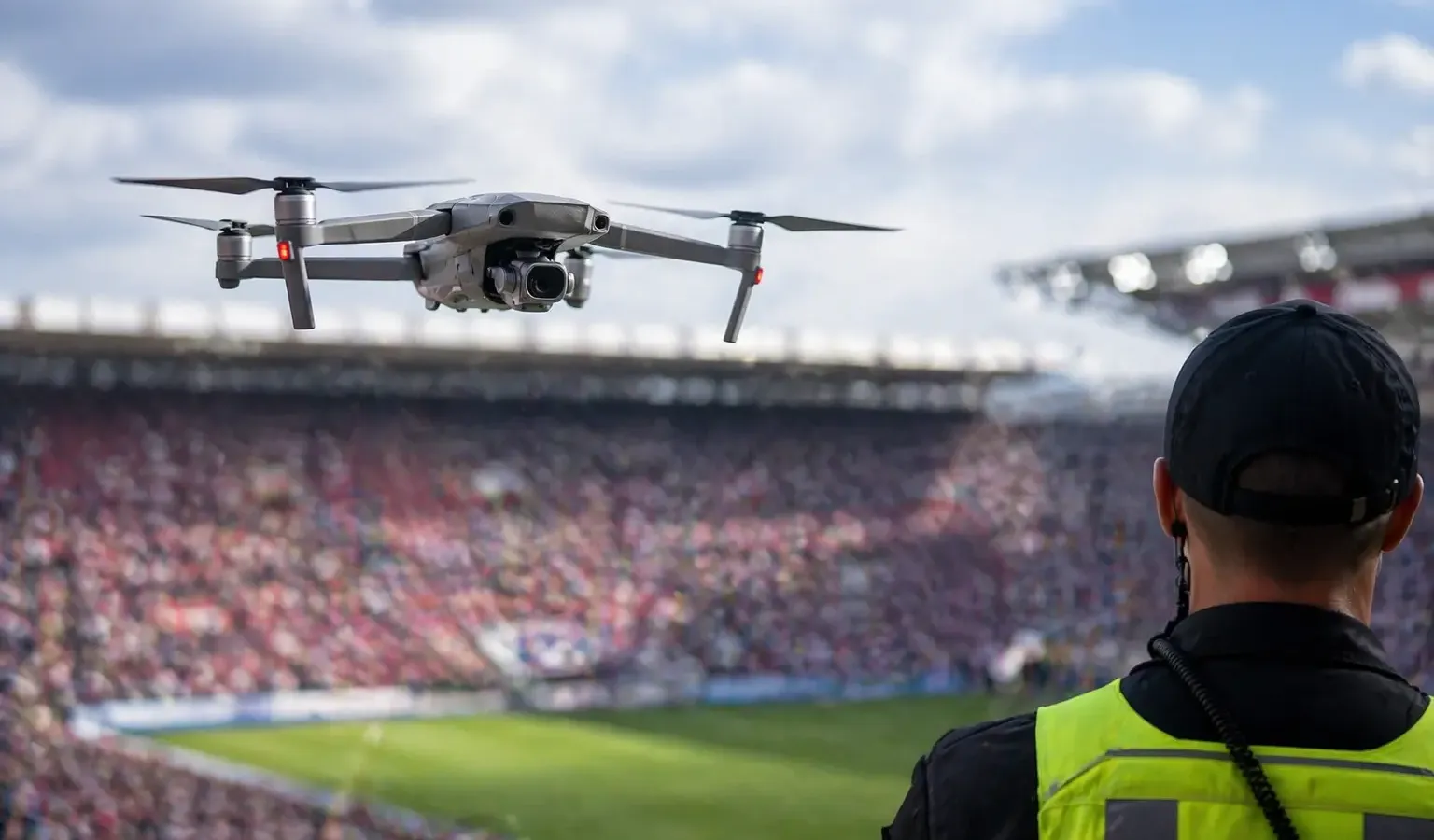
The report draws a distinction that matters for event planners: a weaponized drone is not required to cause serious harm. A single unauthorized UAS over a stadium can delay matches, trigger evacuations, and produce crowd panic. The operational disruption scenario — low-tech, low-cost, high-impact — is assessed as more probable than a direct attack.
That distinction shapes how security agencies should be allocating resources. Preparing only for worst-case kinetic scenarios misses the more likely threat.
Where current defenses fall short
Detection technology has not kept pace with the threat. The paper identifies persistent limitations: false positives in dense urban environments, difficulty distinguishing between harmless and hostile drones in real time, and an inability to reliably determine operator intent before an incident occurs.
More significant is the emergence of fiber-optic controlled drones. Because these systems use a physical cable rather than radio frequency communication, they bypass RF-based detection and jamming entirely — rendering a large category of deployed counter-UAS tools ineffective against them. That’s not a theoretical gap. It’s a current capability that existing infrastructure cannot address.
Fan zones are the weakest link
Stadiums present a layered security environment with defined perimeters and existing infrastructure. The surrounding areas — fan zones, transit hubs, open plazas — do not. The report flags these as fundamentally more exposed: open airspace, minimal physical perimeter, dense crowds, and little to no existing security infrastructure.
For an event the scale of the World Cup, the security challenge extends well beyond match venues. The airspace above a fan zone watching a game on a screen carries the same risk as the airspace above the pitch.
The CIS report does not offer a single technical solution, because none exists. What it does establish is that effective drone risk management at major events requires interagency coordination, investment in detection that goes beyond RF-based systems, and security planning that treats airspace as seriously as ground-level access. With the World Cup now less than two months away, that planning is no longer optional.