
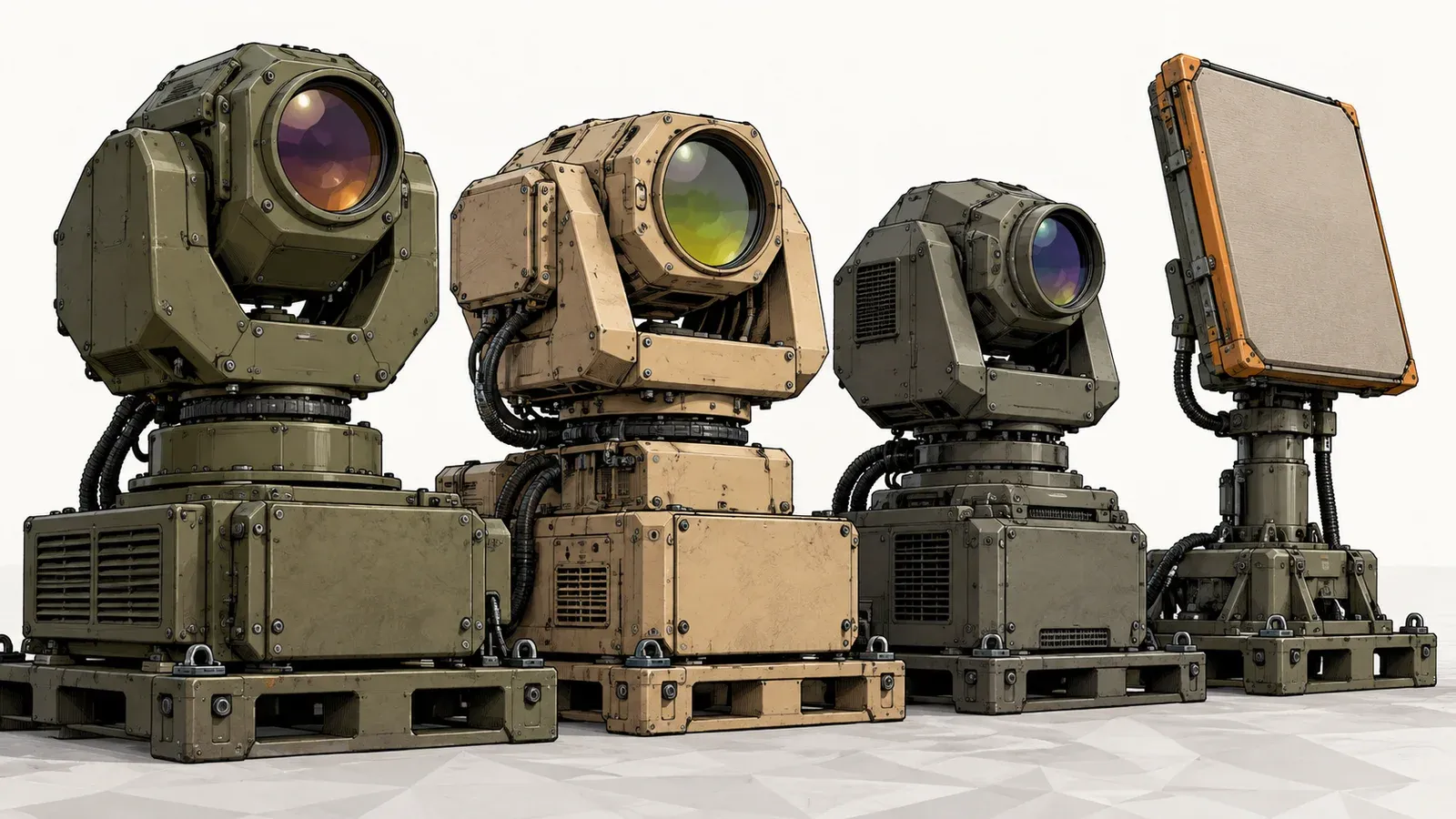
The Pentagon has picked four directed-energy weapons for a year-long trial at bases in the United States. Three are lasers, from AeroVironment, Kord and Boeing, and one is a high-powered microwave, Epirus’s Leonidas. Joint Interagency Task Force 401, the Army-led counter-drone office, announced the choice on 5 October.
Congress ordered the trial in the 2026 defense authorization act. The department wants data on what the weapons need, what they cost and how best to run them. Brig. Gen. Matt Ross, who heads the task force, said there is “no silver bullet” against drones.
Eight months after El Paso
In February a laser aimed at a drone over American soil closed an airport. The FAA shut the airspace over El Paso after Customs and Border Protection used a Pentagon laser near Fort Bliss without coordinating with it, according to the Associated Press.
The FAA and the Pentagon then watched a live-fire demonstration at White Sands, New Mexico, in March. On 10 April the FAA said such lasers, with proper controls, “do not pose undue risk to passenger aircraft”. AeroVironment says the laser tested there was its LOCUST.
In May the task force named five bases for the trial: Fort Huachuca, Arizona; Fort Bliss, Texas; Naval Base Kitsap, Washington; Grand Forks Air Force Base, North Dakota; and Whiteman Air Force Base, Missouri. The October announcement did not say which weapon goes to which base, how many will be fielded, or what the trial costs.
Three lasers and a microwave
A laser has to hold its beam on one drone for a few seconds to burn through it. A high-powered microwave disables the electronics of every drone inside its beam at once, which is why Epirus pitches Leonidas against swarms. Epirus says Leonidas disabled all 61 target drones in a 2025 demonstration in Indiana, 49 of them in a single swarm.
AeroVironment’s entry is a palletised LOCUST, the laser line it gained when it bought BlueHalo in 2025. The Army signed a $464.8 million production contract for a vehicle-mounted LOCUST in September. Boeing says its Compact Laser Weapon System comes in 2- and 5-kilowatt versions. Kord, a subsidiary of the contractor KBR, sells its Firefly as a mobile laser on a pallet.
Fewer sign-offs
Three days before the selection, on 2 October, the department told its own offices to stop holding counter-drone deployments up. Its memo tells approvers to treat delay as an operational risk. Legal reviews of counter-drone weapons should take about 10 days, and the services may not repeat a weapons safety review for the same system and use.
An approver who does not act within 30 days is to be reported to the Secretary of War’s office. The memo does not change the law on when the military may bring down a drone at home.
Other lasers and microwaves get their chance in December, at a shoot-off at Dugway Proving Ground, Utah. Ross said in August that a strong showing there “can immediately result in a purchase order”.