
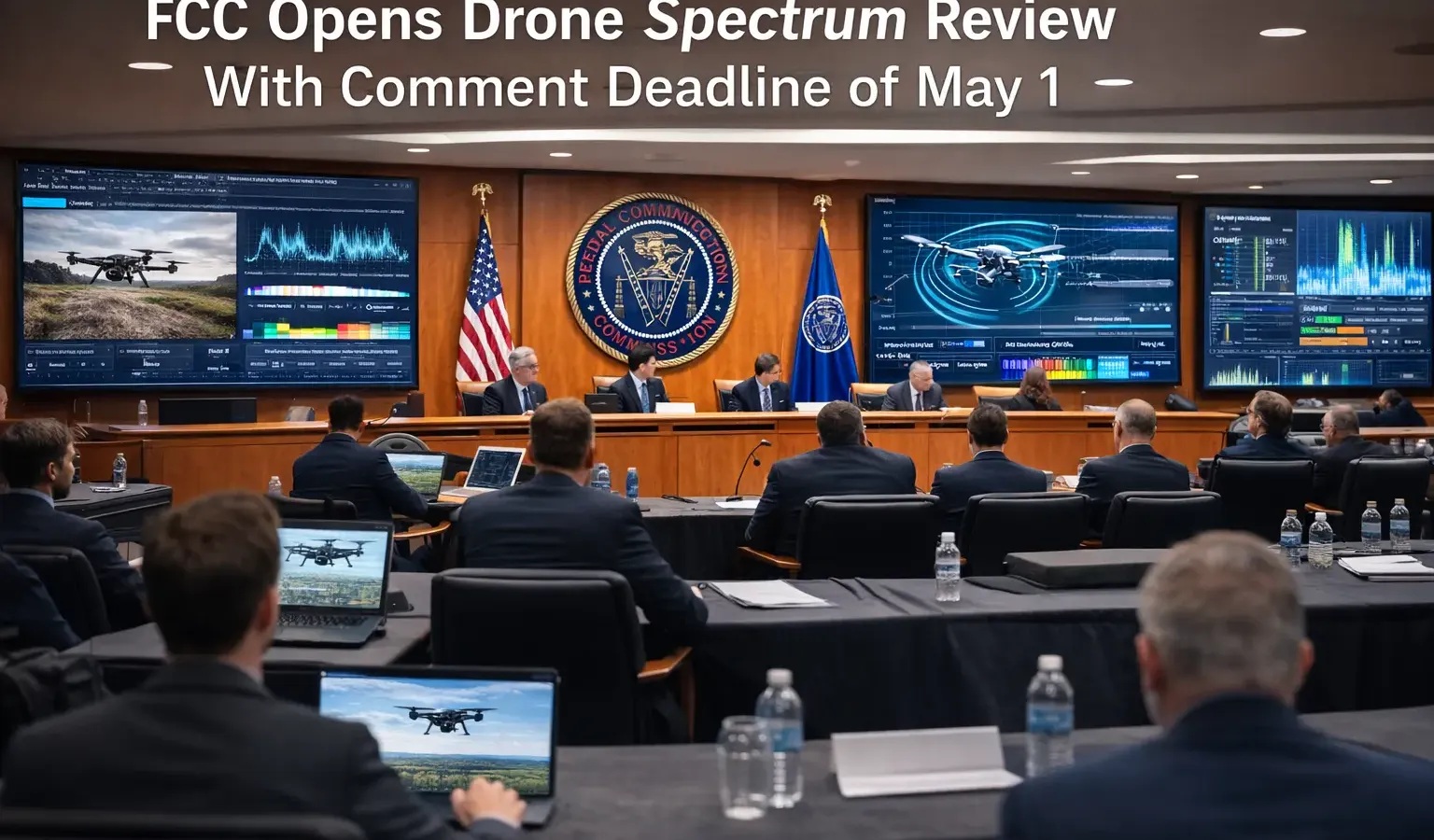
The FCC wants to know if American drones are running out of airspace — not physical airspace, but radio spectrum. On April 1, the agency’s Wireless Telecommunications Bureau released a public notice asking how the U.S. should restructure spectrum access for drones, with comments due May 1.
The proceeding follows two Trump executive orders from June 2025 directing federal agencies to pursue “American drone dominance.” The FCC has moved aggressively since then — adding foreign drones to its Covered List in December, granting 227 experimental UAS approvals since January 2025, and now opening this broader review. Spectrum is the next piece.
Why Unlicensed Bands Are a Problem at Scale
Most drones today operate on unlicensed spectrum — the same 2.4 GHz and 5.8 GHz bands used by Wi-Fi routers and Bluetooth devices. That works fine for short-range flights. It starts to break down when operations become safety-critical.
BVLOS flights require a stable, continuous command-and-control link between drone and operator. A momentary dropout that causes a consumer quadcopter to hover in place becomes a serious incident when the aircraft is 15 miles away delivering cargo or inspecting a pipeline. The FCC’s notice acknowledges this directly: the reliability standards for advanced commercial operations may need to approach those of traditional aviation.
What the FCC Is Actually Considering
The notice covers several distinct questions. On experimental licensing, the agency is asking whether to create a dedicated UAS license category, pre-approved test corridors, and blanket authorizations for qualified developers — changes that would reduce the friction that currently slows companies trying to test new communications systems.
On licensed spectrum, the FCC is revisiting the 5030–5091 MHz band, which was allocated for drone control links and given initial service rules in 2024. The question now is how to accelerate actual use. The notice also asks whether airborne operations should be permitted in flexible-use bands — including LTE and 5G cellular frequencies — which currently restrict aerial use.
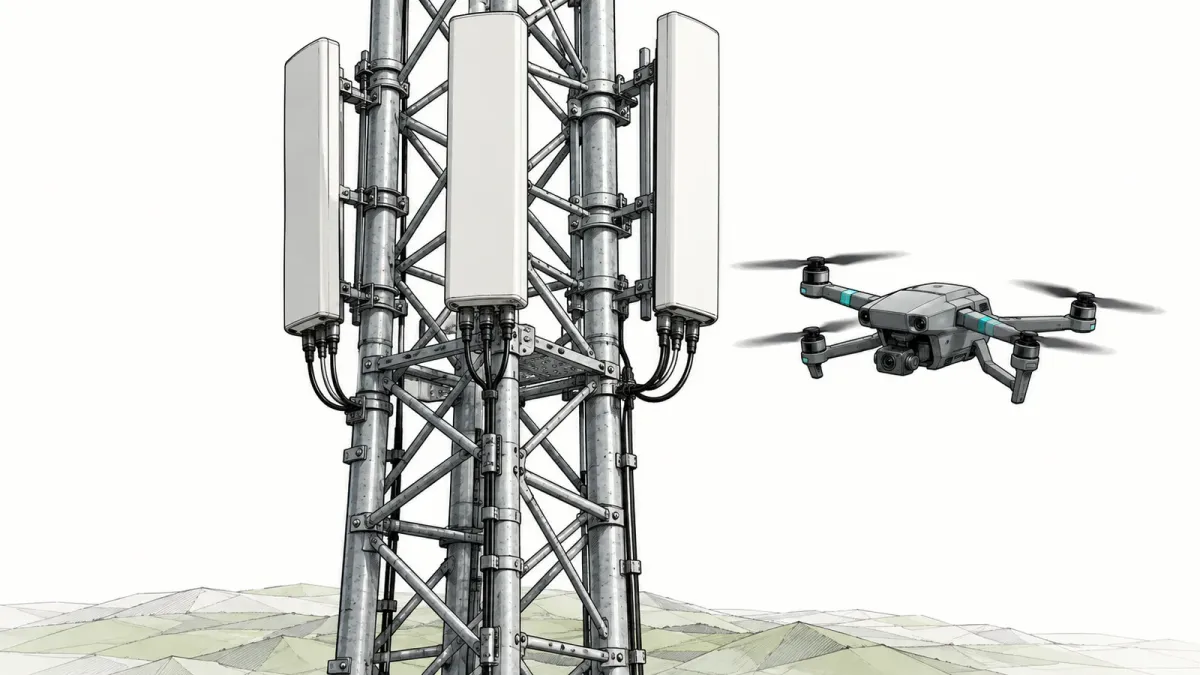
A third area involves dedicated infrastructure. Can existing mobile networks carry large-scale drone traffic, or will drones eventually need their own spectrum layer? The notice floats a multi-band future: 450 MHz for long-range links, 24 GHz for radar, millimeter-wave for high-bandwidth data.
FCC Chairman Brendan Carr, who visited an Anduril test site in Texas ahead of the notice, framed the proceeding in explicitly competitive terms. The U.S. is not just setting domestic policy — it is trying to establish the technical standards that other countries will follow.
The Interference Problem Doesn’t Go Away
More spectrum access for drones means more transmitters in the air. The FCC’s notice is candid about this: every drone is also a radio, and as fleets scale, interference risk to mobile networks, aviation systems, and GPS increases. The agency is asking how to expand drone access without degrading the services that everything else depends on.
That tension — growth versus interference — is the hardest part of this proceeding to resolve, and it’s where industry comment will matter most.
What to Watch
Reply comments close May 18. The stakeholders who will shape the outcome include drone manufacturers pushing for more licensed spectrum access, telecom carriers wary of airborne interference into their networks, and public safety agencies trying to standardize drone communications for law enforcement use. The FCC is also asking specifically how to encourage state and local agencies to buy American-made drones — a procurement angle that ties spectrum policy back to the supply chain push already underway.
The practical effect of this proceeding won’t arrive quickly. Spectrum rulemaking typically takes years. But the direction is set: the U.S. government has decided that reliable communications infrastructure is as important to drone scaling as airspace rules, and the FCC is now the agency making that call.