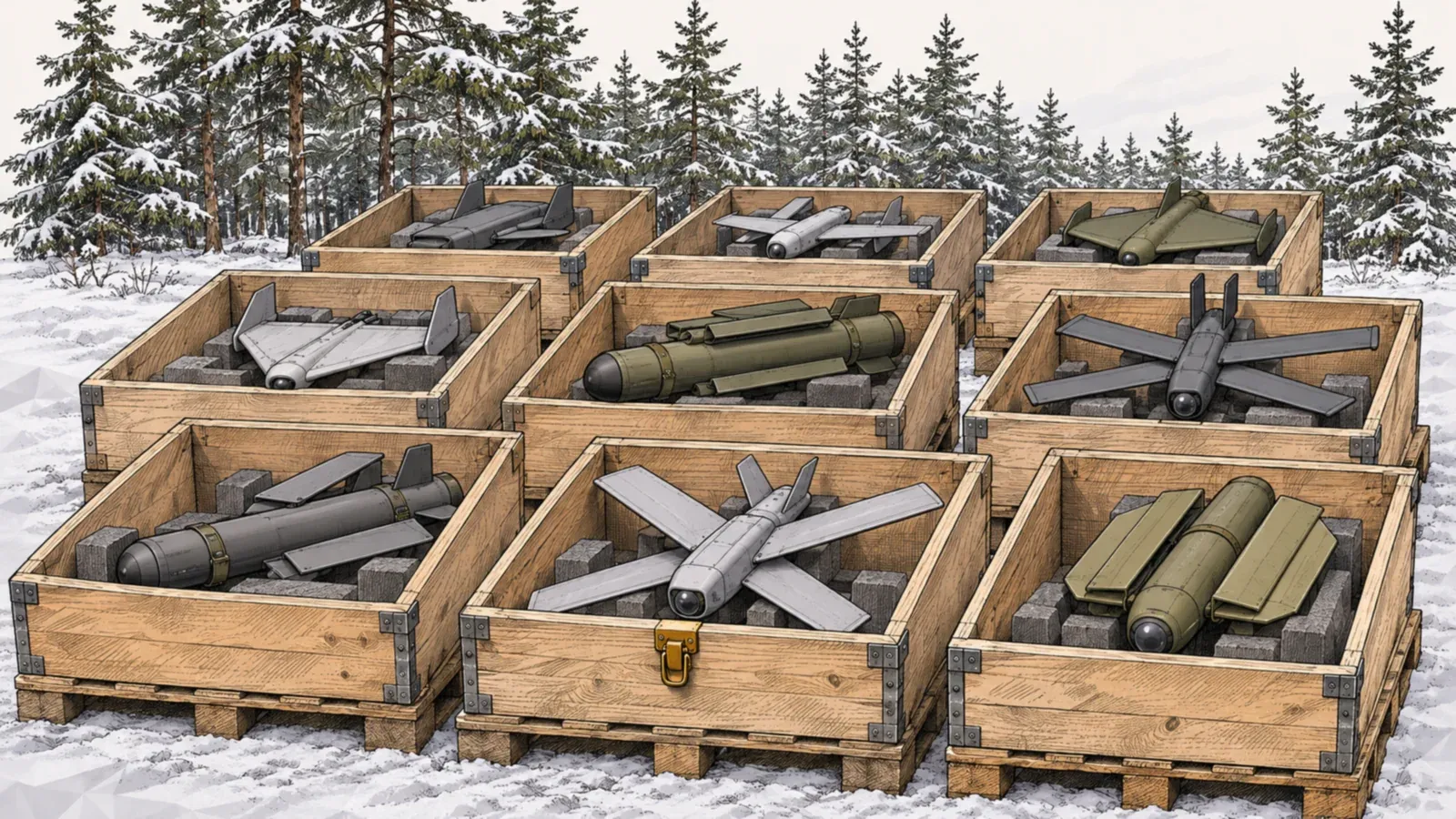
Estonia has signed framework agreements with 60 sellers of loitering munitions, who share a ceiling of €400 million over seven years. Defence Minister Hanno Pevkur gave the count in a written answer to 22 members of parliament dated 29 June.
The Estonian Centre for Defence Investments named the winners in a decision of 11 December 2025. The agreements, signed from January 2026, sit in the Estonian Defence Forces’ public document register. FlightBrief found no announcement of them by the centre or the ministry.
Who is on the list
The 60 include AeroVironment, AEVEX Aerospace, Anduril’s British arm, Helsing, Destinus, Elbit Systems, Rafael and Diehl Defence. KNDS holds two with Delair, Rheinmetall’s Italian unit RWM Italia holds one, and so do Poland’s WB Electronics, India’s Tata Advanced Systems and Ukraine’s Ukrspecsystems.
Estonian companies lead 24 of the 60 bids, by FlightBrief’s count. KrattWorks is in four of them.
Israel Aerospace Industries, which sold Estonia loitering munitions in 2023, was invited to bid in June 2025 but is not among the 60. The documents do not say whether it bid.
A low bar, by design
To qualify, a firm needed three sales of loitering munitions or similar aircraft worth €10,000 in total over three years. A firm without sales could instead show development at technology readiness level 2 to 3, an early design stage. The centre wanted the widest possible competition, Pevkur wrote.
Applications came from 74 firms; 70 were invited to bid and 131 bids arrived. Every bid that met the conditions got an agreement, because the tender set no limit on the number of holders.
The members’ questions turned on one holder, Meeruse Technologies, registered in January 2025. Pevkur replied that the law gave the centre no grounds to exclude a firm for having no employees or turnover. Meeruse met every condition together with another company whose capacity it relied on, he wrote.
What the agreements commit
They oblige Estonia to buy nothing. Orders go through mini-competitions among all holders, where price counts for at least half of the score, alongside delivery time, quality and security of supply, according to KNDS’s agreement. Prices are capped for the first year, and later rises are limited to 3 percent a year.
FlightBrief found no announced order under the framework. The agreements run for 84 months, or until orders reach €400 million.