
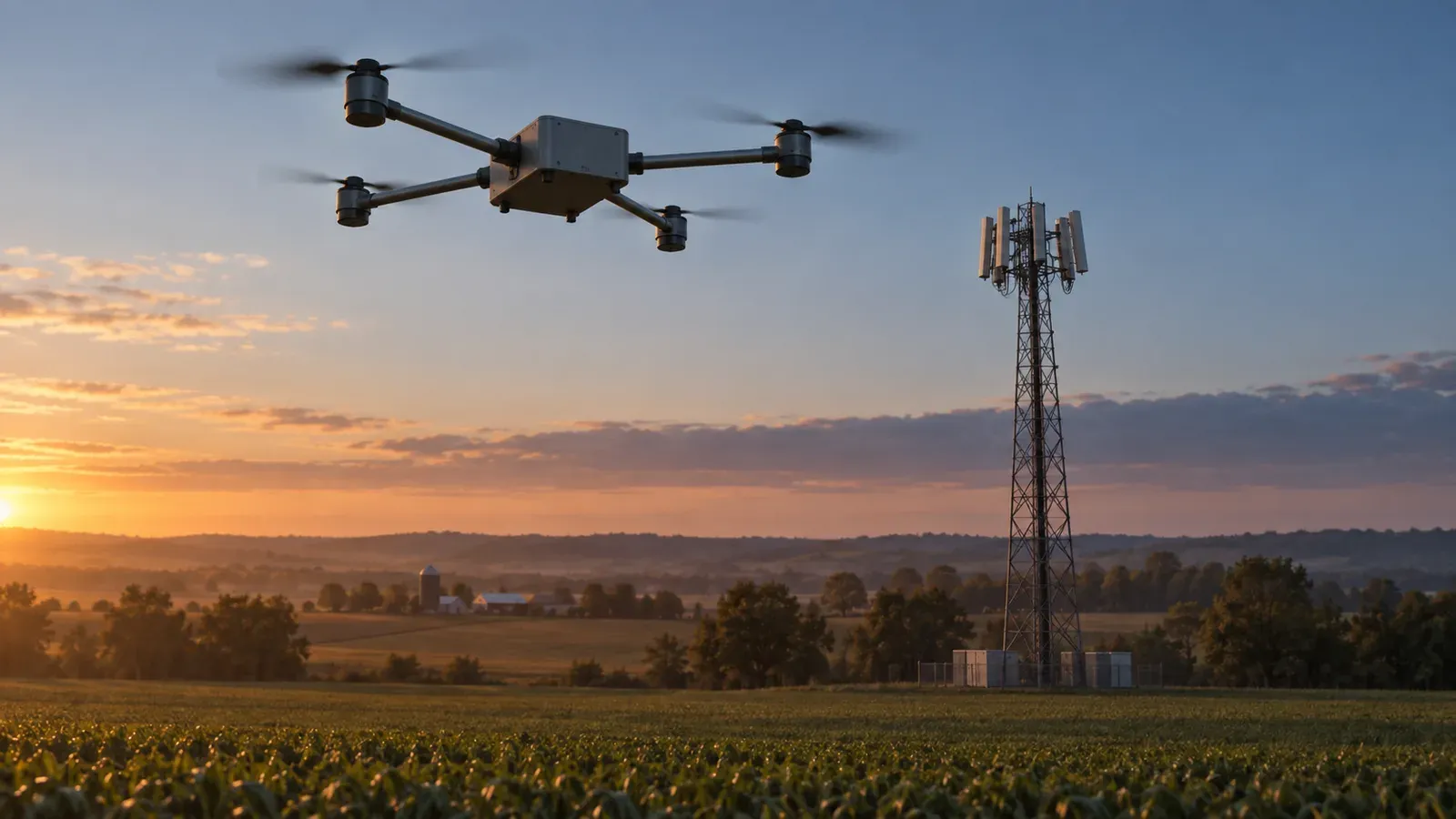
The FCC has waived eight of its own rules so that up to 200 drones and 2,000 private pilots can measure whether mobile networks work in the air. The order runs until 1 October 2029. Joel Taubenblatt, chief of the Wireless Telecommunications Bureau, and Andrew Hendrickson, chief of the Office of Engineering and Technology, signed it on 11 September.
The test belongs to the Department of Transportation. Its Mobile Network Aviation Assessment Program puts an app on general aviation pilots’ ordinary phones and a certified module on drones. Each one logs the signal it sees at altitude into a DOT database. DOT wants to know whether cellular, satellite direct-to-device and sidelink can carry “mission-critical aviation safety services”: Remote ID, command and control, detect-and-avoid, and finding drones that should not be there.
Nobody has that data nationwide. A phone in a cockpit cannot choose which band it uses. Several bands are licensed on the condition that nothing airborne transmits in them; one rule bars “cellular telephones” in “airborne” aircraft in the 800 MHz band, and others cover 2.5 GHz and 3.45 GHz.
A pilot running the app could break those rules without knowing which band the phone had picked. So the FCC lifted them for the programme’s participants.
The waiver lists 18 band groups the app and module may use, from 600 MHz up to 47 GHz. They include FirstNet’s public-safety band, CBRS at 3.55 to 3.70 GHz and the 3.7 GHz C-band. The FCC’s footnote says the list includes bands that never needed a waiver. The point is that every band a phone might land on is now covered.
The conditions are tight. The app may only read what a consumer handset normally reads, may report no more than once every two seconds, and must switch off for any participant DOT removes. The modules must pass FCC equipment authorisation and the carriers’ own certification, cannot be transferred, and are decommissioned when the waiver ends. Transmissions must stay over the contiguous United States and “may not cause interference to wireless networks.”
The FCC judged up to 2,200 devices at a time, spread across the country, “unlikely to pose a significant or widespread risk” to terrestrial networks.
Christopher Nassif, a senior scientist at DOT, wrote the November 2024 white paper the order cites. Unmanned aircraft, he wrote, “are set to vastly outnumber manned aircraft.” A large share of them fly where crewed aircraft are not required to broadcast their position.
Cellular already reaches those places on the ground. Whether it reaches them at 400 feet, above antennas tilted toward the ground, is the question the programme exists to answer.
It is the same docket, GN 26-74, in which the FCC asked the industry in April how drones should get spectrum. Wing told the agency in that docket on 8 September that its Covered List rules risked grounding it.
Part 108, the rule that would replace site-by-site approvals for flights beyond the pilot’s sight, has been at the White House since 10 July. Its 90-day review window ends on 8 October. The DOT testing it would lean on runs to 30 September 2029.